HEY! Get updates to this and the CD and 7" blogs via Twitter: @VinylUnderbite

Saturday, 28 October 2017

Faust - 'Rien' (Table of the Elements)

Table of the Elements – now that's a great label, one that managed to make the compact disc form beautiful and desirable, while emphasising an axis of musical experimentation that embraced the past and present. And what could be a better fit for that aesthetic than Rien, the 1994 'comeback' album from Faust, or at least two of the members. This is a fucking impressive collection of dark juju improvisations, with a few guests (Michael Morley, Keiji Haino, and Steven Wray Lobdell so that's an impressive mix of guitar gods, too) and a thick, spacious roar that burns throughout (even during the quiet parts). While the classic Faust albums all had some sort of songforms present here and there, this abandons that in favour of pure horizontal sound painting. This rages with a focused intensity, hardly the sound of nothing as the title indicates, and it moves in often spellbinding ways. This is still, at times, rock music; the long jam whose title is just symbols is built around a pounding drumbeat and has some vocals, chanting 'listen to the fishes' (which makes sense given the symbols); it's the most Faustesque track, the link to the 70s, as there's that ragged kosmische structure that provides a basis for mega-psychedelic layers on top. The last few minutes gel into a high-level drone piece, where the industrial basis emerges; losing oneself in this is a quarter-hour well-spent. There's a heavy sense of dynamics throughout Rien; 'Eroberung Der Stille, Teil II' spends its first half building up around layers of metallic scraping, until the bottom suddenly drops out and allows space for a new, nocturnal malevolence to emerge, with a guitar/theremin interplay that screams for understanding but offers none. The second track, '?', likewise drops to nothing near the end and with a sudden straining to make out detail, attains transcendence. Closer 'Eroberung Der Stille, Teil I' builds a foundation before turning, as if to look at adjacent scenery, and finding a conclusion in some neoclassical strings, melodic yet uneasy. Rien may or may not be classic Faust – I'm not sure how to grasp the lineage of the band, since the original was a market-based assemblage by a marionette-pulling producer, and was always implied to be a freeform collective anyway – but it's a fantastic accomplishment, a very different flavour to the 1970s records but as rewarding. There's still the same sense of the studio as instrument here, which maybe is thanks to Jim O'Rourke's production; it's hard to know what he contributed and what was the vision of the musicians, but a perfect balance is felt between live instrumentation and creative editing. The bilingual, spoken credits at the end remind me of old Robert Altman films, and that's sort of controlled chaos is a nice metaphor for Faust's greatest work, which this definitely ranks up there with.

Faust - 'Seventy One Minutes Of...' (ReR)

Usually if the duration is in the title, I find the task of listening daunting. Maybe that's the reason I never gelled with Seventy One Minutes Of Faust, which is really a combination of their last LP Munich & Elsewhere with some 70s-recorded miscellany, released much later. This hodgepodge lack of cohesion is also part of the problem - even though there's some great, zany art rockin' at play here (the blown out "Baby', or 'Don't Take Roots'), it's certainly not a coherent, self-standing statement like So Far or IV. And the presentation is murky and confusing - the titles are even hard to read on the back of the CD, the artwork rote and uninspiring. It feels a bit like the Faust version of Incesticide, scraping the barrel for completists, at least before their 90s reunion and subsequent split into two competing strains of Faust. Listening today, it's a lot better than I remembered it being, though there's no classic cuts, and the fact that there are seven tracks named 'Party' makes it hard for any to be memorable. These 'Party' tracks are actually the stronger material, though I'm not sure how many of them were intended for release; the fidelity is very crisp (the electronics on 'Party 1' float above the gurgling improv swamp, sounding like something from a more contemporary electronica-indie scene) and they just feel a bit jammy, even for Faust. There's some alternate versions of known Faust commodities; the first 'Party' is a slower take on the song from the beginning of Tapes, with a really nice layer of spacey guitar that brings this into Cosmic Jokers territory. 'Party 5' sounds like British art-rock, maybe some post-Art Bears RIO band. The closer, 'Party 4', includes everything and the kitchen sink (and lots of babbling in English and German). Despite how satisfying most of these tracks are if taken individually, it somehow doesn't add up to feel like much. Yet this stays on the shelf, and will be upgraded to a vinyl edition if one comes by, because, well... you never know.

Wednesday, 22 July 2015

Fathmount - '6-string Renderings' (New American Folk Hero)

I still have a CD player! It's just that, see, I moved, and when I got to my new place my CD collection sat in boxes in the closet for a few months until I finally constructed some sort of shelf for them. And now they sit here again, but are flanked by a bunch of things in front of the shelves, which is the nice bonus that I don't have to look at them (cause who wants to look at CD spines in 2015, amirite?) but also means I often forget I have them, and thus this Elbow Cinderblock Glass Mastered Constructor Bags universe I've been chipping away at over the years gets neglected. Picking up where we left off, we being me of course, I/us find this jewelcased CDr by Fathmount, who is apparently someone named Wilson Lee. I found this out with Google, see, which has little else to say about Fathmount. But the title give you a hint of what's inside; it's electroacoustic improvisation, built around hammered string, and recorded in a close-mic'd manner for some high spritzy parts and in an ambient room vibe for the deep lows and low-mids. The five tracks all have names like 'Rendering acoustics' and 'Rendering Feedbacks', and the tendency is towards the building of a personal soundworld rather than any flashy showoff guitar techniques or clever editing. 'Rendering Acoustics' has very irritating interruptions in the vibe, some cheap DOD-fuzz, and a plodding monotony that, despite the language I used in this very sentence, is pretty great. 'Rendering Feedbacks' is a dense wall of electroacoustic buzz, with some screaming electronics (or, I guess, feedbacks) gesturing towards an overcast night sky. It's a bit of Birchville Cat Hostel. 'Rendering Pitches' has a staticky assonance around its various tones, and then 'Rendering Layers' comes crashing in like a teenage fuzz guitar symphony - it's a series of power chords played with 4-track line-in majesty, and it could be a demo from the grunge years, eventually attaining a buildup of overtones and making it resemble a minimalist composition. The closer, 'Render harmonics', is pretty much what it says; it's not completely clear what the difference is between 'rendering' music and simply 'playing' it, but the overintellectualisation of Fathmount really ends there. The harmonics are nice and irregularly spaced, making this feel akin to a pastoral, environmental experience as opposed to some rigid, mathematical exercise. Most of the pieces on this disc outstay their welcome, and there was such a glut of string-based electroacoustic drone people from this time people that it's hard to make this really stand out. But it's relatively controlled, and makes nice work with the amateurish home-recording tools that were so commonplace.

Monday, 15 September 2014

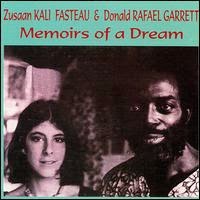
Zusaan Kali Fasteau & Donald Rafael Garrett ‎– 'Memoirs Of A Dream' (Flying Note)

You can count me among the fans of the Sea Ensemble's 1974 ESP-Disk album We Move Together; it's one of the less heralded ESP titles, coming so late, and maybe due to it not really fitting into any prevailing jazz scene at the time. Don Garrett is one of those figures who was integral to the 1960's free jazz movement without being recorded that many times. He played on Coltrane's Kulu Sé Mama and in the Archie Shepp band for a bit, and was generally described as being an energetic, visionary figure who knew and worked with just about everybody, without ever carving out much of a name for himself as a band leader or soloist. His long-term relationship with Kali Fasteau (they were married during the 70s) led to the Sea Ensemble, a duo group that somehow sounds like so much more. I came across this double CD at some point in my exploratory jazz phase and often throw it on when I want to escape into the fluid movement of wind. These are two live concerts, and they are flowing, evocative improvisations. The first disc is live in Leiden, 1975, and in two 15-minute tracks they start a whirling ball of organic sounds rolling that never really stops, though it has its ebbs and flows. It finally comes to a gentle, slow resolution where the air, channeled by these two, finds a resting place. The second disc is live in Turkey, 1977, towards the end of their relationship. This is divided into twelve tracks, all untitled, and has a less crisp, more woody fidelity. They start by speaking an introduction with some abstract language and then blow through some intense interactions. There is a lot of piano and upright bass, as well as the wind instruments heard so prominently on the first disc. The fidelity makes it sound a bit like a recording from the 1920's or at least the pre-modern times; this gives it even more of an otherworldly feel than the instrumentation does. There's a good bit of vocals here, sprinkled overtop like a spice, and the two get into a push-pull thing sometimes, particularly when both on wind instruments (I can't always tell what's what; some of the flute-like sounds feel too wooden in origin to be a proper flute, but then not quite a shakuhachi sound either). When it gets more of an edge (the double-bass bowing is warm and wet, but there's a more sharp, grating bowed instrument later on that when plucked sounds like a sitar or something Indian), it stands out from the other tracks. This musical freedom, where a jazz basis is synthesised with the pulse of worldwide traditional music, feels more like a way of life than a genre. Though many of my favourite 'jazz' artists trend towards this type of output (Alice Coltrane, Don Cherry, etc.), they're really outliers when compared to the standard jazz narrative, of Wynton Marsalis and Lincoln Centre and public radio and all that shit. Maybe this is just a bunch of hippie shit, but these artists found their path and stayed committed and true, and you can hear it between the notes and spaces of the recordings. The passion here is expressive, but it's as much about the overall artistic vision (visually, as well as in the way they lived) as it is about the sounds themselves. I find inspiration here more from that aspect than from the actual recordings, because as pleasurable and psychedelic as it can be to be carried on Fasteau and Garrett's flying carpets, it's more of a call to arms, to get off this laptop and pick up my busted-ass clarinet and start exploring my own outer spheres. That's not to diminish how great this is - it's an hour and a half well-spent, alive and breathing.

Sunday, 14 September 2014

Family Fodder - 'Savoir Faire: The Best Of' (Dark Beloved Cloud)

When Dark Beloved Cloud released Savoir Faire in '98 it came a time when this collective seemed defunct and long-forgotten; nothing had been heard since 1983's somewhat messy All Styles and this hybrid post-punk/experimental/art-pop band was music to my ears. The title track, opening things off, set the pace - a fast bit of aggressive art-pop with a French-sung bridge and two members of This Heat playing along. I was hooked and fell in love with this disc, which to this day is still the go-to Family Fodder record for me. Probably the greatest hits nature here is beneficial for this band, a ragtag collective that mostly gravitated around Alig Fodder and Dominique Levillain; being a completist gets you a few extra gems for sure (some of which we talked about on the vinyl blog) but the average Joe can survive for a long time with just this. There was a time almost 20 years ago where I could not believe such crazy sounds were hidden in rock's recent past; this was before the reissue fatigue set in and this sort of very British experimentation wasn't as commonplace. There's still an audacity and ridiculousness to 'Playing Golf (With My Flesh Crawling)', merging Residents/Snakefinger riffs and Eno-esque vocal delivery into something so fundamentally absurd it's become a classic. That it hews to a clever pop structure as well, with hooks, tension and release all delivered at the appropriate moments, is also key; Family Fodder are experimentalists in affect, lyrics, and production a lot of the songwriting is just bubblegum. Take 'Cold Wars', which in an alternate universe would have been a chart topping smash, or 'Film Music' (spoiler: it's empty); if only this songwriting talent had been used for less Gestalt purposes! But this is how I love it, a demented kitchen-sink mentality that did a lot to inspire my own music at the end and in the years following. Most of the Family Fodder singles are on here, which is nice as they are harder to find; this includes the double-punch of the Blondie 'Sunday Girls' cover (done actually pretty straight) and then the spastic rave-up 'DEBBIE HARRY', which at the time this came out was more well-known via Unrest's two sorta-covers, 'Winona Ryder'. A lot of British music in the early 80s was embracing dub and reggae forms and you hear a bit of this in Family Fodder, most notably in the dub take on an Erik Satie Gymnopede (or is it a Gnossiene?), though the curation of this disc otherwise stays away from that tip. Even still, it's a long way from an Adrian Sherwood production, being too self-consciously goofy. The last few tracks are where things trail off, containing their absurd 'Dinosaur Sex', a song I don't actually enjoy yet I can't imagine releasing a representative disc of Family Fodder without it, and a few later pieces from the 80s, previously unreleased, none particularly memorable. The last few years have got the band back together, though they haven't seemed to make much of a splash and I personally haven't heard any of it.

Wednesday, 10 September 2014

Fall of Saigon (Gazul)

By the time the first minute of Fall of Saigon has passed, the punchy opener 'Visions', I feel like I am listening to a slightly more aggressive version of Young Marble Giants. The simple synth pulses, gentle rhythms, and Florence Berthon's earthy, intimate voice are certainly from the same playbook, and this comes a few years later (1981-1984) so the influence is probably undeniable. But this was reissued probably due to the presence of Pascal Comelade, who later built a career performing in more experimental and improvised arenas, and these nascent tendencies are heard throughout. And when guitarist Terry Den takes over vocals, as on 'On the Beach at Fontana' (chanting a James Joyce poem) or 'She Leaves me All Alone', we get a more industrial, trance-like feel. His dour voice recalls the Cure or just about anyone else making dark punk-edged pop in 1982. (Could the band name refer to the This Heat song, or is it a reference to French political history?) This music is familiar through its obscurity, being another one of those rediscovered gems that keep surfacing at fairly regular intervals. That balance of serious and heavy lies throughout - there's fun live recordings of covers (Kraftwerk's 'The Model', TV Personalities 'Part Time Punks', and The Doors's 'The End') sequenced together in the middle, but it doesn't feel like filler, instead like a fleshing out of the personality of this band, represented 30 years later by this single CD. I don't know how Fall of Saigon fits into the trajectory of French art-rock; I so want to shoehorn them into some lineage between Mahogany Brain and Cheveu, but that's just forcing myself to rationalise great music into a historical narrative. The of-its-time sound and the covers inevitably situate this as a product of its time, but it's a time that we've been celebrating for three decades and I see no reason to suddenly stop.

Sunday, 24 August 2014

The Fall - 'Grotesque (After the Gramme)' (Cog Sinister)

This is a weird CD release because it pre-pends some early singles ('How I Wrote Elastic Man', 'Totally Wired' plus b-sides 'City Hobgoblins' and 'Putta Block'), but without anything in the liner notes indicating that. So 'Pay Your Rates' actually kicks in as track 5, and then Grotesque proper begins. Not a problem here - the singles complement the album perfectly - it's just that I only know what the song titles are thanks to my familiarity with the tracks (and the Gracenote CDDB database, of course). Repetition, cited often as an early Fall motif, is maybe most prominent here of any of these early releases - 'Pay Your Rates', 'New Face in Hell' and 'C n CS Mithering' (not to mention 'The NWRA'!) are insanely monotonous, drilling into one's brain with their back-and-forth soul-sucking. It's like a Michael Snow film, except with Smith's sneering lyrics providing a wild unraveling. 'English Scheme' has always been one of my favourite Fall songs, maybe due to the way that the carnivalesque keyboards blast over everything and the geographic evocations within the lyrics tweak my own fascination with British maps By this point, The Fall have evolved out of the punk thing entirely and arecreating something intangible but about their lives in Manchester. It's more confident, perhaps, less prone to hiding between Smith's bile. The keyboard and guitar interplay on 'New Face in Hell' is practically jazz.