Right about now feels like the time that Dave Pearce's music is due for a comeback, not that he ever went away, or became unfashionable. He just became less prolific, and seems a million miles away from any sort of music scene politics these days, still making music how he wants and releasing it now and then (the last being the Instrumentals 2015 record which I have not heard yet). I remember reading about Flying Saucer Attack in zines and other pre-Internet media in the early 90s; reading one particular publication, the name of which I can't remember, it seemed (to me) that FSA were aggressive sci-fi space-rock, as they were reviewed alongside more punk-orientated material. My teenage mind couldn't handle that type of diversity yet, because when I finally got around to hearing them (these were the days where one had to struggle to actually hear the things one read about, especially on a high schoolers budget) I was disappointed; it sounded too abstract, too empty to me. Of course that changed later on, once I started to investigate minimalism and drone, and to make my own music which wasn't a million miles away form this sound. Further is probably now the record of theirs I appreciate the most, as it feels like the best balance between all of FSA's various tendencies (folk song vs drone piece, harmony vs dissonance, lo-fi vs hi-fi). Owning it on CD gives it a glassy shimmer, and on a track like 'For Silence', which moves between all of these tendencies, I can only imagine how it must sound coming from vinyl's dynamic range. Acoustic guitars are dominant, and there's quite a lot of arpeggiated picking, making this more obviously folk-based than I was ready for as a teenager. Listening now, I can really hear the saturation in British traditional music, even if 'To The Shore' sounds more like Labradford than Shirley Collins. This reinvention of British folk form was something else totally lost on me not just as a youngster, but later when I discovered and really fell in love with FSA; it's only now that I really feel this is truly the next step in a lineage. Rachel from (the wonderful) Movietone was still a core part of the band here and her voice on 'Still Point' creates a spooky ambience that most directly recalls the strong tonality of the British female voice; that the song is drenched in delay and reverb doesn't inhibit this comparison, but if anything amplifies it. This is music that can be taken in peripherally, as a semi-ambient bouquet of suggestions, or full-on direct into the centre of one's skull. 'In the Light of Time' and 'She is the Daylight' function perhaps as the two anchors of this record, both built around Pearce's earnest voice, over delayed arpeggios, the mildest percussive elements (just tapping the guitar body, I think) and then the bright light tones that drift overtop, like the album artwork rendered into sound. This music has aged very, very well, and the close connection I feel to my physical body when listening to it separates it from that which is based in trends or the cultural context of the time. It's easy to lose oneself in this record, and somehow it feels short even though it's 'proper album length'.
I'm trying to listen to every CD I own, that has a spine, because the slim/thin discs I keep in a different storage box so we'll do those at the end. Right now it's alphabetical by artist, though let me stress that this is a much lower priority than the LP blog.
HEY! Get updates to this and the CD and 7" blogs via Twitter: @VinylUnderbite
Showing posts with label aggregate psychedelia. Show all posts
Sunday, 10 December 2017
Saturday, 28 October 2017
Faust - 'Rien' (Table of the Elements)
Table of the Elements – now that's a great label, one that managed to make the compact disc form beautiful and desirable, while emphasising an axis of musical experimentation that embraced the past and present. And what could be a better fit for that aesthetic than Rien, the 1994 'comeback' album from Faust, or at least two of the members. This is a fucking impressive collection of dark juju improvisations, with a few guests (Michael Morley, Keiji Haino, and Steven Wray Lobdell so that's an impressive mix of guitar gods, too) and a thick, spacious roar that burns throughout (even during the quiet parts). While the classic Faust albums all had some sort of songforms present here and there, this abandons that in favour of pure horizontal sound painting. This rages with a focused intensity, hardly the sound of nothing as the title indicates, and it moves in often spellbinding ways. This is still, at times, rock music; the long jam whose title is just symbols is built around a pounding drumbeat and has some vocals, chanting 'listen to the fishes' (which makes sense given the symbols); it's the most Faustesque track, the link to the 70s, as there's that ragged kosmische structure that provides a basis for mega-psychedelic layers on top. The last few minutes gel into a high-level drone piece, where the industrial basis emerges; losing oneself in this is a quarter-hour well-spent. There's a heavy sense of dynamics throughout Rien; 'Eroberung Der Stille, Teil II' spends its first half building up around layers of metallic scraping, until the bottom suddenly drops out and allows space for a new, nocturnal malevolence to emerge, with a guitar/theremin interplay that screams for understanding but offers none. The second track, '?', likewise drops to nothing near the end and with a sudden straining to make out detail, attains transcendence. Closer 'Eroberung Der Stille, Teil I' builds a foundation before turning, as if to look at adjacent scenery, and finding a conclusion in some neoclassical strings, melodic yet uneasy. Rien may or may not be classic Faust – I'm not sure how to grasp the lineage of the band, since the original was a market-based assemblage by a marionette-pulling producer, and was always implied to be a freeform collective anyway – but it's a fantastic accomplishment, a very different flavour to the 1970s records but as rewarding. There's still the same sense of the studio as instrument here, which maybe is thanks to Jim O'Rourke's production; it's hard to know what he contributed and what was the vision of the musicians, but a perfect balance is felt between live instrumentation and creative editing. The bilingual, spoken credits at the end remind me of old Robert Altman films, and that's sort of controlled chaos is a nice metaphor for Faust's greatest work, which this definitely ranks up there with.
Friday, 19 July 2013
Es - 'Kaikkeuden Kauneus Ja Käsittämättömyys' (Fonal)
Es is Fonal label chief Sami Sänpäkkilä's project, and he's always kept one of the lower profiles amongst his own label's output, releasing a handful of albums over the past decade. This one is from 2004, though it was recorded mostly a few years before, and features ten generally low-energy explorations of texture, ambience and space. Female vocalists adorn it, sometimes front and centre (as on the opening cut 'Surullisille, Onnettomille...') and sometimes in a more distant fashion. It's well recorded, but not too hi-fi -- the CD uses homespun digital technology to create a soundplace that is crisp when it wants to be, though not particularly distinctive at that. There's a lot of synth, played in spooky, Goth-leaning styles, but then with acoustic instruments creeping in to give everything a somber, Finnish take on the 4AD aesthetic (or at least, what used to be the 4AD aesthetic). My Finnish isn't good enough to understand any lyrics or titles, but that's part of the pleasure of these artists - if the lyrics are great, we live in mystery, and if they're bad, we're spared the awfulness. There's no shortage of the ol' digital delay, here sounding more like a skipping CD - making a track such as 'Puutarhaan laskeutuu höyhen' an uneasy blend of here and there, reminding me of Biota/Mnemonists except lacking the exuberance. Digital static pokes in as well, and the start-stop nature of the textures sometimes jars against the songwriting. But I've always found this Es disc interesting - it's a lot less freakazoid than Avarus or Kemialliset Ystävät, yet far from conventional. The title track is the closer, a 9 minute bad trip that's built around an indecisive church organ and some eerie chanting. It requires a monk-like attention span but offers a rewarding heart-lift when it's complete.
Saturday, 7 July 2012
Dialing In - 'Cows in Lye' (Pseudo Arcana)
The first Dialing In release I heard, Ketalysergicmetha Mother, was a shocking blast of ur-drone - when I was far past the tipping point of enjoying psychedelic drone, or so I thought. What a shockingly great record that was! Dialing In, a one-woman project from Seattle, somehow transcends the plethora of mediocre drone-swirl that was being made at the time this was released. 2006 was only six years ago, yet it somehow feels like so much has changed. Cows in Lye isn't exactly placid meditation music - it's active, and demanding in its horizontality. Dialing In plays with the contrast between something moving quite a lot and something moving hardly at all, and the rumbling disconnect of frequencies between. The formula is mostly unchanged throughout - a thick heavy base, a few layers of sounds pulling in different directions, mostly occupying isolated frequency bands - and a balance between chaotic and repetitious. There's something that happens throughout which is hard to describe, but gives Cows in Lye a warped, ethnic-music feel. Some of the higher, more active sonorities, particularly in cuts like 'City of Dogs', sound almost like a field recording of Indian street musicians - all melting shenhai's and other such Hindu horns. Herb Diamante guests on track two, with a long vocal rant which is similarly distant and untouchable - it lends the track a real 'Napoleon and Josephine' feel, and the words (a call to prayer, if we are to believe the title) slip and slide around direct meaning. In the length jam-out track, 'Thorazine Eclipse', a three-chord progression is felt in warm fuzzy synthpads, recalling familiar echoes of AM radio hits; though it's wordless, the cadence grounds the piece and it feels accessible. In some ways it's like a precursor to the whole hypnogogic pop thing that started happening soon after this; certainly Dialing In's peers would be the Skaters/James Ferraro, both in milieu, geography (the West coast is close enough) and construct. Cows in Lye throughout has that "mid-fi" feeling - there's enough of a dynamic spectrum to allow separation/clarity, though static unknowing is of course the raison d'être of this. As much leeway as any individual moment might have, there's something incredibly exact about this constructions, which is why it's so remarkable.
Thursday, 31 May 2012
DENT - 'Stimmung' (Magnetic)
I have already confessed my love for Camper Van Beethoven earlier in these annals, but we have yet to investigate the weird side projects that I also love. Don't worry, we'll have our dalliance with Monks of Doom eventually, and just a warning - Meridian is gonna get the Golden Cinderblock Award. But what about the lesser-known offshoots? Sadly, I don't have any Hieronymous Firebrain records apart from some old dubbed tapes, but shit, what I wouldn't give to hear 'Waning Crescent Love Spit' right now! (Thanks, Bandcamp, for making this possible). DENT is J. Segel and V. Krummenacher, and a cadre of friends, all under silly pseudonyms like 'Stands-Naked-In-Moonlight' and 'MC Salmon'. DENT is where these guys let loose and make weird, improvisatory music with an experimental edge, except it's not that wild -- there's an organic, instrumental quality to almost everything here. The vocals are largely extemporized and when the porny guitar leads (a tendency evident in later Monks of Doom records, for sure) take over, it's undercut by the babbling vocals and music-box overdubs ('April Fools' and the opening track 'Make Me 1 w/everything' are great examples of this). Stimmung, which has nothing to do with the Stockhausen work, as far as I can tell, was a strange record for me to listen to when I was 16. I enjoyed the songforms most of all - the subtle pop hooks, the almost-too-far excursions into dance and hip-hop forms, and most of all the mystique. My deep love of all things Camper Van Beethoven certainly helped, and the spirit of irreverence remains throughout this even if the ha-ha is absent. The epic jam here is 'Manchester Mystery House', a long techno-influenced maximalist overture, but my pick is 'Some Grey Clouds', an eerie, discordant experiment that lets the space take over - a sea of isolated vocal snippets and tentative string plucks, with a tidal ebb and flow beneath. Sure, Stimmung is tossed-off, but after listening to it now for the first time in a decade, I'm enjoying it far more than I would have ever imagined. There's a tension between the more lyrical, Krummenacher-driven tunes ('Paris? New Mexico' is a wonderful psych-folk jam, reminding me a bit of CVB's 'Form Another Stone' from II & III) and the (I assume) Segel-drievn freakouts. There's an untitled bonus track, because everyone putting out their own CDs in the mid-90s was obsessed with this possibility, and it's the most straight-ahead folksong imaginable (even against 'Won't You', which has a Holy Modal Rounders-style warp to it), a rant about then-California governor Pete Wilson. Dated as it may be now, it's a voice of countercultural protest that needed to go somewhere, though I understand why they left it off the track listing. At just over an hour, Stimmung slightly wears out its welcome, but it's interesting to wonder why these musicians feel so free here and not as free on their other Magnetic-label projects. It's not like the goof quotient is shocking or uncommercial; but then something makes this out of step with indie music of 1995, indeed.
Monday, 21 May 2012
Debris - 'Static Disposal' (Anopheles)
This 76-minute collection of Debris' lone 1976 private-press LP + all sorts of rehearsal materials is a window into a warped vision of music coming from Chickasha, Oklahoma. 35 years ago I like to think the South and Midwest was producing the freakiest freaks of all, whose geographic isolation makes them all the more special. Historical excavation has given us gems such as the Pataphysical revue CD from Tuscaloosa, Alabama and whatever the Reverend Dwight Frizzell was doing in Kansas. Debris are somewhere in-between these outer limits and semi-local peers like the Embarassment, except in that proto-punk way. Static Disposal is a great bit of fun, though it's the first eleven tracks, comprising the album proper, which are at least remotely polished. This is closer to the ramshackle rock of Pere Ubu or Chrome than anything too exploratory, as everything is grounded by the guitar-bass-drums, though with synths, saxes, and a vocal delivery one part glam, one part asylum. Part of the joy of Debris is their obscurity and unlikely surroundings - we can only imagine what they were aspiring to be, though I guess it's all laid out in the 32-page booklet that I got bored reading. Some songs like 'One Way Spit' and 'New Smooth Lunch' are utterly brilliant in their cracked grandeur. In other moments, the affected Bryan Ferryisms of the vocalists (either Johnny Gregg or Oliver Powers) achieve actual empathy, such as in the bluesy 'Tell Me'. A Lizard King even appears in 'Flight Taken', perhaps the most sci-fi and drugged of these tunes (though you have to wonder what you could score in Chickasha). There's no rock pyrotechnics here, not much improvisation - instead a warped cry of misfits from a true East ga-bumfuck. After track 11 we start to get into rehearsal tapes which are of course much more fun, though harder to listen to. We get a better sense of the band as a unit here, as on 'Zebra Ranch' where there's actually a pretty cohesive bass/drums groove at points. 'Gun' is the longest and freakiest workout, with damaged Echoplex guitar noise, and a monotonous rhythmic bed behind. It's a testament to one-take magic, and the wonder of the CD format means we can experience it today,
Wednesday, 19 October 2011
Damon & Naomi - 'with Ghost' (Sub Pop)
The post-Galaxie career of Damon & Naomi is a gentle, beautiful one - they've made some great records, though none really as memorable as More Sad Hits, which I don't have, but this collaboration with Ghost ain't too shabby. I remember D&N as being a more mellow, downbeat, and minimal group that Galaxie 500, but the opening cut of this ('The Mirror Phase') sounds almost exactly like the song 'Tell Me' from On Fire, except with slightly more ethereal vocals and an updated production from Kramer's whole thing. Ghost isn't really on this record - just 3 of them - but to many, Masaki Batoh and Michio Kurihara ARE the meaty part of Ghost, and they're both here. Despite the presence of a bitingly psychedelic Japanese psych band, D & N keep things pretty genteel. Batoh limits himself to acoustic guitar, making this resemble his Ghost in the Darkened Sea record far more then the orange one with the long name. And Ghost's more prog-rock tendencies, which really stuck out at me the one time I saw them live, are completely absent. This is much more a Damon & Naomi record and the Japanese presence barely warrants the title this CD gets, but it's a wonderful balance. It's only really the penultimate track, 'Tanka', where sounds converge into a large, powerful ball of magic - but even still, it's not a particularly dissonant one, and it doesn't overstay it's welcome. Most of the tracks exist in a folk-pop strumniverse that recalls other artists at times - for example 'The New World' has shades of the Sallyangie - and actually has two covers 'Blue Moon' is the umpteenth cover of Alex Chilton but the melancholy is cut, quite a bit actually, especially compared to the His Name is Alive version I've listened to so many times. Tim Hardin's 'Eulogy to Lenny Bruce' closes the disc with the lowest energy, most restrained psychedelic freakout that I can think of - it's repetitive and trippy, but it's laid back to the point that when it ends - with the slightest energy from Kurihara - I barely noticed.
Tuesday, 21 April 2009
Acid Mothers Temple & The Melting Paraiso UFO - 'New Geocentric World' (Squealer)
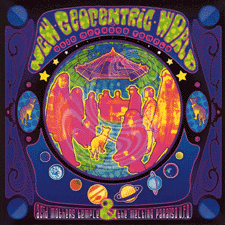
Acid Mothers Temple already feel like a million years ago even though this came out less than a decade back; they produced such a glut of releases over the next five years that I had to cut myself off at some point. That said, I couldn't remember anything distinct about New Geocentric World as compared to any of their other releases; that said, I can't remember anything distinct about any of their other releases as compared to any of their other releases (you follow?) except for maybe La Novia cause it has the Italian singing on it. A shame, because I'm sure any and all of their records contain great great moments but they all fall into the dark chasm of my memory, chalked up to "too much, too soon". New Geocentric World opens with a tease of synth and voice but then expodes into the total freakout that you expect, sounding a Sister Ray taken to the next dimension (and also sounding like a lot of other things, but we won't go there). It's a bit too free jazz for me to trance out and stare at the album artwork (which is too small in the CD format but still cool cause it looks like it was created using the ol' IMPROCES.EXE for DOS).
I don't know if Acid Mom's would have aroused much interest if they were, for example, just a couple of fat dudes from Texas or Ohio making the exact same music and releasing the exact same records with the exact same artwork. I'm not saying this to be condescending or cynical, but Nipponese exoticism certainly was worth a bit in my world of 2001. I caught them on the tour for this album, which I remember being powerful and overwhelming and a bit cathartic (occuring just after 9/11) but then again, I was looking for art to be powerful and overwhelming and carthartic then. I do rememer them playing one repetitive, melodic riff for about 25 minutes straight to open their set, and then later doing it again as an encore. Which is kind of what 'Psycho Buddha' (the opening track) is like, except minus the focus or melody. And it finally ends and we get into some of the smaller group tracks, like 'You're Still Near Me Everytime' which is a dissonant soul song with Haco wailing overtop. It's totally like Kenneth Higney fronting Dzyan. 'Universe of Romance' is centered around a melody on some traditional instruments but with fucked up synths and in-and-out vocals; in some way it anticipates the free-folk trends in mid-decade American underground music.
But then 'Occie Lady' takes you to a Nagoya bar-b-q where they octopus balls are cooked well-done. 'What Do I Want To Know (Like Heavenly Kisses part 2)' is the big ambient organ jam that sorta ties everything together - maybe the mirror image of 'Psycho Buddha' or maybe it's just everything else from the record put into a blender. Shades of Terry Riley, Fursaxa, Windy and Carl, and most of the early Kranky Records roster, all culminating in some tender ambient guitar work that is probably the most traditionally lovely sounds on the whole (long) disc.
Subscribe to:
Posts (Atom)


.jpg)
