 The artwork to 2001's followup to Object Holder reminds me somewhat of playing an old 320x200 game like Doom or Castle Wolfenstein 3-D. The music, well, it's actually a great deal clearer than Object Holder's mess. The same elements are there - deconstructed folk melodies driven by acoustic guitar and accordion, sweet female vocals popping up now and then, and chaotic, effected percussion. But there's just a tad bit more space between these elements, allowing a bit of light to shine through. I still find this an almost unbearable listen to manage in one sitting: 37 tracks, 76 minutes. Yow. These guys n' gals sure make the most of the CD format. The booklet is thick too, with page after page of digital artwork. The lead vocalist has changed to Genevieve Heistek, though she sounds a lot like the last one, and there's still only about six tracks with lyrics. The folk melodies are amplified a bit but now you can hear the details much more. The chaos under the melody of 'Port' is spastic, yet constrained, and it has a nice sound of prog-blueballs. I usually get sick of accordion when I listen to Biota, but 'Landless' is mixtape-perfect: His Name is Alive dipped in a Gallic marinade and hung out to dry with a swarm of aggressive insects. It's unfortunately just a bit too short. And in the lengthy instrumental middle of this record (20 tracks, in fact) we get a lot of styles. 'Sleeping Car' is made up of difficult intervals, sounding cold, Eastern and oblique yet bouncy and fun. 'Snake Out' is practically ecstatic, though still with effected drumming and spazzy acoustic strums everywhere. When the accordion returns, its a bit disappointing, but I am listening to my second 70+ minute Biota CD in a row. There's some real neoclassicisms here, which have made me rethink my standard line on Biota. Because, I like this band - I own three of their CDs plus the Mnemonists stuff, and generally think they're somewhat underrecognised, particuarly since song-based deconstruction has gotten some steam lately. But I've always been slightly hesistant to fully commit to Biota, because I thought they were too eclectic. Yeah, check it - I mean, I have (I think) diverse taste in music, and I think it's great if you can merge influences from 20th century classical, folk music, prog rock, pop, etc. I used to think that Biota were merging too many sounds and this is why I never could really click with them - they sound more like an encylopedia than a group of musicians expressing themselves through art. But listening now, I realise that's not so much the case. What really hurts Biota is that I don't think they conceptualise a 'record' the same way that I do - as a standalone canvas that can be used for various forms of expression, etc. The rules and format of that canvas may be unfortunately predetermined through a variety of nasty precedents, such as 60s rock music, economics, etc. -- but it still exists. And this is a record - perhaps I would enjoy them live more. Biota, I think, sees the CD as being a 75-80 minute receptacle for their recordings and thus they dump everything they can on there, not really thinking about how the listening experience plays out on the other end. For example, there are some lovely, delicate moments in the middle of this album - spooky piano textures, breathing silences, creeping strings, etc. The problem is, I don't even notice them because we're talking about tracks that are somewhere in the mid-20's out of 37 short pieces. I think someone could probably craft an entire release around a few of these tracks; it's all presentation, you know? But Biota, they just shove them in there among all the chum and deconstructed pop jams, so the impact is somewhat lessened. I think if this was 2 35-minute albums I listened to separately, I would 'hear' the music much more than I do now, because around track 17 I just started to glaze over it. Even if I listened to 2 35-minute albums back to back, I think I would hear them better. Because it's presentation; it's the canvas that really matters but the frame is important too. So there is my beef and that also explains why I'm going to say little about the second half of this record, apart from the parts with singing which stand out, especially 'Words Disappear' which is awesome. Because I wasn't really listening, due to the above mentioned philosophical disagreement. And also, enough is enough with putting effects on the drums!
HEY! Get updates to this and the CD and 7" blogs via Twitter: @VinylUnderbite
Showing posts with label collective. Show all posts
Showing posts with label collective. Show all posts
Wednesday, 16 December 2009
Biota - 'Invisible Map' (Recommended)
The artwork to 2001's followup to Object Holder reminds me somewhat of playing an old 320x200 game like Doom or Castle Wolfenstein 3-D. The music, well, it's actually a great deal clearer than Object Holder's mess. The same elements are there - deconstructed folk melodies driven by acoustic guitar and accordion, sweet female vocals popping up now and then, and chaotic, effected percussion. But there's just a tad bit more space between these elements, allowing a bit of light to shine through. I still find this an almost unbearable listen to manage in one sitting: 37 tracks, 76 minutes. Yow. These guys n' gals sure make the most of the CD format. The booklet is thick too, with page after page of digital artwork. The lead vocalist has changed to Genevieve Heistek, though she sounds a lot like the last one, and there's still only about six tracks with lyrics. The folk melodies are amplified a bit but now you can hear the details much more. The chaos under the melody of 'Port' is spastic, yet constrained, and it has a nice sound of prog-blueballs. I usually get sick of accordion when I listen to Biota, but 'Landless' is mixtape-perfect: His Name is Alive dipped in a Gallic marinade and hung out to dry with a swarm of aggressive insects. It's unfortunately just a bit too short. And in the lengthy instrumental middle of this record (20 tracks, in fact) we get a lot of styles. 'Sleeping Car' is made up of difficult intervals, sounding cold, Eastern and oblique yet bouncy and fun. 'Snake Out' is practically ecstatic, though still with effected drumming and spazzy acoustic strums everywhere. When the accordion returns, its a bit disappointing, but I am listening to my second 70+ minute Biota CD in a row. There's some real neoclassicisms here, which have made me rethink my standard line on Biota. Because, I like this band - I own three of their CDs plus the Mnemonists stuff, and generally think they're somewhat underrecognised, particuarly since song-based deconstruction has gotten some steam lately. But I've always been slightly hesistant to fully commit to Biota, because I thought they were too eclectic. Yeah, check it - I mean, I have (I think) diverse taste in music, and I think it's great if you can merge influences from 20th century classical, folk music, prog rock, pop, etc. I used to think that Biota were merging too many sounds and this is why I never could really click with them - they sound more like an encylopedia than a group of musicians expressing themselves through art. But listening now, I realise that's not so much the case. What really hurts Biota is that I don't think they conceptualise a 'record' the same way that I do - as a standalone canvas that can be used for various forms of expression, etc. The rules and format of that canvas may be unfortunately predetermined through a variety of nasty precedents, such as 60s rock music, economics, etc. -- but it still exists. And this is a record - perhaps I would enjoy them live more. Biota, I think, sees the CD as being a 75-80 minute receptacle for their recordings and thus they dump everything they can on there, not really thinking about how the listening experience plays out on the other end. For example, there are some lovely, delicate moments in the middle of this album - spooky piano textures, breathing silences, creeping strings, etc. The problem is, I don't even notice them because we're talking about tracks that are somewhere in the mid-20's out of 37 short pieces. I think someone could probably craft an entire release around a few of these tracks; it's all presentation, you know? But Biota, they just shove them in there among all the chum and deconstructed pop jams, so the impact is somewhat lessened. I think if this was 2 35-minute albums I listened to separately, I would 'hear' the music much more than I do now, because around track 17 I just started to glaze over it. Even if I listened to 2 35-minute albums back to back, I think I would hear them better. Because it's presentation; it's the canvas that really matters but the frame is important too. So there is my beef and that also explains why I'm going to say little about the second half of this record, apart from the parts with singing which stand out, especially 'Words Disappear' which is awesome. Because I wasn't really listening, due to the above mentioned philosophical disagreement. And also, enough is enough with putting effects on the drums!

Tuesday, 21 April 2009
Acid Mothers Temple & The Melting Paraiso UFO - 'New Geocentric World' (Squealer)
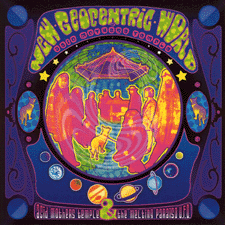 Source: Promo copy received from Squealer, I'm guessing August 2001.
Acid Mothers Temple already feel like a million years ago even though this came out less than a decade back; they produced such a glut of releases over the next five years that I had to cut myself off at some point. That said, I couldn't remember anything distinct about New Geocentric World as compared to any of their other releases; that said, I can't remember anything distinct about any of their other releases as compared to any of their other releases (you follow?) except for maybe La Novia cause it has the Italian singing on it. A shame, because I'm sure any and all of their records contain great great moments but they all fall into the dark chasm of my memory, chalked up to "too much, too soon". New Geocentric World opens with a tease of synth and voice but then expodes into the total freakout that you expect, sounding a Sister Ray taken to the next dimension (and also sounding like a lot of other things, but we won't go there). It's a bit too free jazz for me to trance out and stare at the album artwork (which is too small in the CD format but still cool cause it looks like it was created using the ol' IMPROCES.EXE for DOS).
I don't know if Acid Mom's would have aroused much interest if they were, for example, just a couple of fat dudes from Texas or Ohio making the exact same music and releasing the exact same records with the exact same artwork. I'm not saying this to be condescending or cynical, but Nipponese exoticism certainly was worth a bit in my world of 2001. I caught them on the tour for this album, which I remember being powerful and overwhelming and a bit cathartic (occuring just after 9/11) but then again, I was looking for art to be powerful and overwhelming and carthartic then. I do rememer them playing one repetitive, melodic riff for about 25 minutes straight to open their set, and then later doing it again as an encore. Which is kind of what 'Psycho Buddha' (the opening track) is like, except minus the focus or melody. And it finally ends and we get into some of the smaller group tracks, like 'You're Still Near Me Everytime' which is a dissonant soul song with Haco wailing overtop. It's totally like Kenneth Higney fronting Dzyan. 'Universe of Romance' is centered around a melody on some traditional instruments but with fucked up synths and in-and-out vocals; in some way it anticipates the free-folk trends in mid-decade American underground music.
But then 'Occie Lady' takes you to a Nagoya bar-b-q where they octopus balls are cooked well-done. 'What Do I Want To Know (Like Heavenly Kisses part 2)' is the big ambient organ jam that sorta ties everything together - maybe the mirror image of 'Psycho Buddha' or maybe it's just everything else from the record put into a blender. Shades of Terry Riley, Fursaxa, Windy and Carl, and most of the early Kranky Records roster, all culminating in some tender ambient guitar work that is probably the most traditionally lovely sounds on the whole (long) disc.
Subscribe to:
Posts (Atom)