Heyday was Fairport's album of radio sessions from the early era of the band, but not the earliest - it's all Sandy Denny here, sans-Dyble, and while they were theoretically writing material like 'Meet on the Ledge' and recording albums as great as Unhalfbricking, this collection shows them cutting loose and mostly delivering rave-up cover versions. If Fairport was folk-rock, this shows that the rock came first; the only British traditionals appear as the bonus tracks, though this CD is all about the bonus tracks. I actually had the original Heyday CD, which was only the first 12 cuts here, and then upgraded to this expanded reissue when it came out. The album proper is almost a classic of its own - the band goes through Joni Mitchell, Leonard Cohen, Johnny Cash and Gene Clark songs with varying aplomb, and there's a few originals such as the great 'If It Feels Good, You Know It Can't Be Wrong', by Thompson and Ashley Hutchings. Of course, no more false words have ever been written, but on that track, the debt to American rambling folk-rock is laid on thick. This is perhaps the least British Fairport Convention ever -- their smashing version 'Reno, Nevada' shows how much they fetishised American folk culture -- but some of the most fun. And Joe Boyd contributes to the liner notes, explaining how he pushed them to define a more distinctly British sound, which I think everyone can thank him for. These are Peel Sessions from before the term really existed and thus have that thin, spontaneous Maida Vale sound, with reverb on the live vocals (most evident on 'Fotheringay's haunting background voices and 'Si Tu Dois Partir'). It's only the bonus disc that starts to creep later, material-wise, into 1969 and into far more British fare. Here we get 'Nottamun Town', 'Fotheringay', 'Reynardine' and 'Tam Lin', all of which defined and distinguished Fairport Convention from the other masses of Dylan-gazing folk-hippies, and you can hear why. Thompsons's shredding on 'Nottamun' is great with Martin Lamble's congas, and it's like a hash den at times, all the more affecting when juxtaposed with a strident Jackson C. Frank cover. The version of 'Tam Lin' to close it out is a scorcher, as good as the album version and a million miles from 'Gone, Gone, Gone' earlier on the disc. It's an appropriate finish to something as conclusively 'fun' as this album, with a burning light that lingers after the disc has stopped spinning.
I'm trying to listen to every CD I own, that has a spine, because the slim/thin discs I keep in a different storage box so we'll do those at the end. Right now it's alphabetical by artist, though let me stress that this is a much lower priority than the LP blog.
HEY! Get updates to this and the CD and 7" blogs via Twitter: @VinylUnderbite
Showing posts with label amazing american music made in europe. Show all posts
Saturday, 10 May 2014
Thursday, 4 April 2013
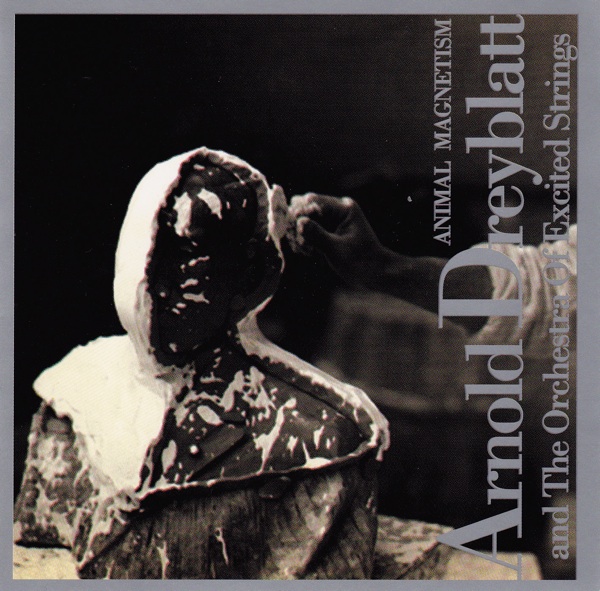
Arnold Dreyblatt - 'Animal Magnetism' (Tzadik)
This is one that blew everything wide open for me. My impressionable teenage mind heard this for the first time (i think) in someone's car, on a cassette, and even still I was quite affected by the power of microtonal music. This is rocking 20th century classical composition, an album to make anyone sit up and take notice. But it's not aggressive, macho, or posturing - it is pure energy, an open, celebratory exploration of sound with a pulsing momentum and a driving urgency. It would be easy to try to read the sound of post-wall Berlin into this, and were I a Greil Marcus type maybe I would try to say that this music celebrates the eclecticism of a new Europe. But I'm not, so I'll just again repeat that this fucking 'rocks'. It's that drum on the opening track, 'Point Rotation', that sets the tone, but it's not a snare - it's a Basque string drum. Yes, even the drums are tuned microtonally and would you expect anything less? There's such a passion behind this ensemble, compared to the more sedate Propellers lineup (only cello/tuba/electric bass specialist Jan Schade remains) that when a deep bowing sound (maybe Schade's cello) saws through the mix, its accelerating rather than retarding. Interesting recording techniques mean that on some tracks, certain instruments are not properly in the mix, so it feels like someone is tapping a bell or block right over your shoulder, as opposed to with the other musicians. The piercing, sharp staccato notes are the brightest sounds on here and work really well against the horns. Everything is distinguished, and it's a composition to celebrate. I know this work like the back of my hand, making this a rare work of classical music that I sing along to. Like 'Propelleres in Love', it ends with a slow, spacious statement, just a note, a rest, and the note again, repeated. Very little gets better than this.
Wednesday, 3 April 2013
Arnold Dreyblatt & The Orchestra of Excited Strings - 'Propellers in Love' (hatART)
Arnold Dreyblatt's music really speaks to me; he might be the minimalist I feel the strongest emotional connection to. This work from the 1980s is given a disclaimer in the liner notes, from the get-go, that it's 'extremely difficult to capture on tape' and we can imagine even moreso on CD. This takes the formula of Nodal Excitation but with a slightly different compositional feel. It's easy to dismiss Dreyblatt's compositions from this decade as basically being 'dung-dung-dung-dung-dung-dung' but that's far beside the point, and not particularly true -- this disc is a very obvious midpoint, compositionally, between Nodal Excitation and Animal Magnetism. Even on CD with my lousy stereo I'm able to feel slowly emerging, thick blanketing overtones building up on every track, and the louder I turn it up, the more there is. A propeller is a good metaphor because this music is propelled along by the incessant beat, though it's often more linear than circular. One thing I love is how infinitely relistenable Dreyblatt's music is. Yeah, it's all overtones, but they sound different every time, and there's no chance of a segment of this music getting stuck in your head like a pop song. This might be true 'eternal music' to borrow a term from LaMonte. The most subtle variations in rhythm make a movement incredibly distinct from the last one. The longest segments of 'Propellers in Love' are 'Odd & Even' and the title track, both almost ten minutes, and the duration benefits the feel; it's really easy to get lost, making the code ('Lucky Strike') all the more amazing, with it's sparse, ringing chords. This is a beautiful composition. As a bonus track, hatART gives us the 15 minute 'High Life', played by just Dreyblatt and Paul Panhuysen. This is a total drone piece, and a lovely one, surely constructed from many of the same frequencies that his other work utilises. It's meditative and anything but throwaway, but definitely of a different state of mind entirely.
Subscribe to:
Posts (Atom)