HEY! Get updates to this and the CD and 7" blogs via Twitter: @VinylUnderbite
Showing posts with label serious exuberance. Show all posts
Showing posts with label serious exuberance. Show all posts
Monday, 15 September 2014
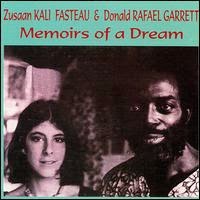
Zusaan Kali Fasteau & Donald Rafael Garrett – 'Memoirs Of A Dream' (Flying Note)

Monday, 17 October 2011
Leo Cuypers - 'Heavy Days are Here Again' (Atavistic)

Sunday, 1 May 2011
John Coltrane - 'A Love Supreme' (Impulse!)
 This ended up on my shelf because I got it for free or someone left it at my house or for some other reason like that. I'm not making an excuse because A Love Supreme is certainly nothing to be ashamed of; but I never actually listen to it, or any other Coltrane records for that matter. And I'm not sure why - I mean, certainly there's a lifetime of rewards to pull out of the grooves on all of those classics (or between the 1s and 0s here). Maybe I'm just a bit sick of hearing about A Love Supreme, and I just never came across any of the others on vinyl. This is certainly the Coltrane album that graces the most university dormitory CD shelves -- wait, who am I kidding? College kids don't own physical pressings of music anymore! But regardless, this is an insanely venerated record that is certainly a bold, confident statement of emerging free jazz spirituality -- I just prefer the more discordant explorations of the Alice/Ali years. Particularly Sun Ship! Now that's a record. But actually listening to A Love Supreme is a supremely harmonious act; the tone of Coltrane's sax is like a giant buttery raft and the Garrison/Tyner interplay is as telepathic as reputed. Everything swirls in a big ball of magic and it's a sound that has become such a template over the past half-century that is almost sounds clichéd. There are some solos of note - or duos at times, like Tyner's leading of the middle part of 'Resolution', with chords so perfectly chosen and Garrison/Jones responding to the chopping with the perfect support. Garrison's solo in 'Pursuance' has that classic, elegant feel, like a wood nymph stepping confidently out of the darkness, wrigging in the spotlight for a bit, and then retreating to some other role. I think a good reason for A Love Supreme's popularity is how peaceful and content it feels, and that it comes just on the precipice of total madness in his own life. Crescent, from about the same time, is just as confident (from what I remember) and it's like one last glance backwards before taking the door to Interstellar Space. Maybe I also have a bit of a snobby elitist chip on my shoulder, just thinking about how for many this might be the one free jazz or Coltrane disc they own. And ironically, the latter is true for me.
Wednesday, 13 October 2010
Can - 'Ege Bamyasi' (Spoon)
 I don't remember where I first heard of Can - probably mentioned in some article or interview. I do remember the first time I decided to listen to them, when I was chatting with a coworker. I was sixteen and I had a job working in a library. There was an older music nerd who worked there and I remember asking him what his favourite bands were. He told me that it was probably Pere Ubu (who I had heard of surely, but not listened to) and Can. To which I replied 'The German band?'. Latter that night I went to a Silkworm gig. Anyway I'm digressing again, trying to babble on about my personal history with this music instead of talking about the actual sounds here. Ege Bamyasi is somewhat of a watershed; things weren't quite the same afterwards though I can't quite put my finger on why. This is a much more smooth, fluid record than Tago Mago. 'Pinch', the opener, is languid and bright, though frantic; it's Jaki Liebezeit stretching out and letting everyone else paint broad watercolour strokes over him. 'Sing Swan Song' is simultaneously ballad and minimalist heartpulse. Czukay's bass is brutal and pummeling despite the soft edges, and Suzuki takes us to a new a place with his emoting. 'One More Night' I can't disassociate these days from the loop that appears as the backing track to a few Joe Frank radio shows, during which you can really focus/obsess on it's disjointed rhythm. I'd like to say that this is a dub approach again, built upon a long jammy riff with most of the changes coming from elements coming in and out - 70's cop guitar, cymbals, Damo's voice, etc. It's three tracks in before you realise that this is a new poppy side of Can, no doubt motivated by the hit of 'Spoon', which is tacked on here as the final track. 'Vitamin C' takes us back to the kinetic repetitive funk of 'Hallelujah', though condensed into three minutes and even more open of a songform. There's enough room here for Damo to get quite lyrical, and while his experimentation on Tago Mago is unparalleled here, by this point it really feels like the man is finding a new voice. It's a Can jam for a mixtape, though it ends prematurely. I always swore it was a lot longer. Irmin brings in a somewhat liturgical organ solo near the end, but this is the church of psychological warfare. And there's a segue into 'Soup', the most 'out' track of Ege Bamyasi. This is a tick-tock Jeopardy game, with harshly squealing white noise and electric piano bumps, all somehow kept contained while constantly threatening to rip itself apart. It's a rocker until it breaks into a more freeform section, sounding almost EXACTLY like an Area record. Damo is even affecting some Italianness (Dago Suzumi? I couldn't resist, sorry), all gutturals, sputterings, and rolled consonants. Irmin is going far more synthy than the soft organs we heard on the earlier tracks, and once again (like the end of 'Aumgn') we have Jaki pushed to the forefront. But it doesn't outstay its welcome (not to imply that 'Aumgn' does!) and quickly takes us to the two pop tunes, 'I'm So Green' and 'Spoon'. The former is an edgy jazz-rocker built around a nice Liebezeit/Czukay shuffle and some arpeggiated jangle. It sets a mood quite similar to what the band did with Mooney, though again with a syncopation they could have only dreamed about in 1968. By the end of it's economical three minutes, we've reached something chaotically psychedelic that I'm still not sure how to read. And 'Spoon' was the tune for a cop show, or something like that. Fair enough, cause it's properly suspenseful, built around an ethereal pop hook, laden in reverb and with haunting background vocals. Hit songs are nothing to be ashamed of, and this maybe manages to capture Can at their peak in just three minutes. I know it lacks the long-form workouts, synth/vocal diversions or instrumental freakouts but there's still something to be said for it. The sense of spacyness - not like Hawkwind, but like Alvin Lucier - is there, despite being a fairly busy arrangement, and while no musician really gets to go for it, there's the sense of collective brainmeld that could only happen when a brilliant band reachers their peak.
Thursday, 3 June 2010
Peter Brötzmann/Die Like a Dog Quartet - 'Little Birds Have Fast Harts No. 1' (FMP)
 This might speak more to my current state of free jazz enjoyment in 2010 but my favourite aspect of this Die Like A Dog marathon (67 minutes!) is the presence of one Toshinori Kondo, a trumpeter who quite frequently employs digital effects on his sound. What this does is provide a balance to the meat n' fire blowing of Brötzmann and the great, yet earthy rhythm section of William Parker and Hamid Drake. The first track is 43 minutes long and it started with Brötzmann exuberantly and/or aggressively bleating away before the band bursts in. Over the course of the whole movement it's hard to really focus as a casual listener, but I guess you aren't supposed to listen to this stuff casually. Kondo's extended vamps are certainly what stands out, being saturated in delay and flange, yet still fleeting and light. It's not like the affected trumpet sounds of Spaceheads, but used more as an accent. Sometimes he flares up and the processing distorts a bit and it has the feeling of sunlight on a freshly Windexed pane, with a minute glimpse of a rainbow refraction. Now, this band is a tribute to Albert Ayler, certainly not the first but there's nothing wrong with that. Ayler's influence on Brötzmann is profound, in terms of wide vibrato and emotive soul-baring thrusting. Kondo works as the Don Ayler, I guess. There aren't any identifiable Albert licks here, but 'Part 2' begins with the sort of melodic wandering that you'd hear in Ayler's Michael Sampson band era, though it quickly erupts into a ball of free not unlike what track 1 sounded like. This is an incredibly long time to spend in a fairly similar musical mode. The band plays, everyone is free, and at points there are solos. It's free jazz as it was in 1997, which is to say an awesome thing to behold and not bad to listen to either. Hamid Drake is an amazing master of rhythm but almost an odd choice for an Ayler-inspired band, as his drumming is much more centered than Sunny Murray (who I would think of as the 'definitive' Albert Ayler drummer, if there is such a thing). He's played with Parker for so long that they have a really natural interaction, and Parker's wild thudding provides a thundering belly over which Drake can dance. When I saw Die Like a Dog live, which I'm guessing was a few years after this, Kondo was gone and Roy Campbell was in his place. I was disappointed on finding this out, though Campbell proved to be a much more emotional player, and his passion was an adequate substitute for Kondo's trickery. The furious nature of the band means that and more deep listening elecroacoustic jazz experimentation is gonna get lost in the shuffle. Don't get me wrong, things do slow down at times -- just not for long. The second piece is a bit more subdued than the first, with a very sparse improvised melodic bit that does have some processed noteless blowing from Kondo, and an odd phasing effect - but it's too little too late. Kondo is a fascinating musician, but I can't stop thinking this isn't the right venue for him. Though Albert Ayler would certianly have been curious to explore electronic experimentation had he lived - I am convinced of that, for whatever reason. The primitive and folky aspects of Ayler's music, which emerge for me more and more as the reason, are probably better tributed in the Art Ensemble's 'Lebert Aaly', or from a tribute group not yet formed. I realise I've always filed this under Brötzmann, following the artist name on the spine, rather than the front of the CD which would put this under 'D'. It also says 'Composed by Peter Brötzmann' which sounds like a bit of credit-claiming cause if this isn't majorly group improvised, then I dunno what is.
Monday, 22 March 2010
Boredoms - 'Vision Creation Newsun' (Birdman)
 My god, it's been ten years since this beast from the East was unleashed! This was the Boredoms' big reinvention, or for those listening more carefully, the next logical step in their progression. Super Roots 7 (or was it 8?) started off with the formula - long, extended pieces built around polyrhytmic insanity, with the usual shrill electronics, pulsing organs and disembodied voices layered in slow crescending waves. Vision Creation Newsun expands it to a whole double album-length, and the result is astounding. I remember getting this CD back in college and totally losing my shit over it. It was also one of the first "big" albums that I heard in its entirety via NAPSTER before it was released domestically though I don't know if that is somehow significant. Maybe I can say that this was a record that changed the way I heard music, arriving at a time when the ways we listen to music were changing. Ugh, I'm starting to sound like one of those shitty Sirius/XM sattelite radio commercials! So on to Vision Creation Newsun: If you wanna talk about a perfect melting between the electronic and organic, this is it. The untitled tracks flow together into one cohesive whole, though there are certainly highlights. The opener is a statement of purpose, with it's sweeping filter banks defining the Boredom's new temple. Track 3 builds up a repeating, ascending riff like something out of Can or Neu! but filtered through Marginal Consort. Throughout everything, the 'anything goes' mentality is scaled back a bit and the emphasis is on duration instead of the short-attention span pyrotechnics that the Boredoms practiced in the early 90s. And oh, what a result. There's thick waves of organ, reverb-affected guitars, bells and percussion galore, and lots of voices that slip away into a distant sea. Best of all are these weird parts that go into power-rock sections - jamming on one long riff over a steady 4/4, or the recurring two-note monotony that makes up track 6's main theme. This organic onigiri is also wrapped in a great deal of digital processing, but somehow the choppy skipping feels more akin to a tremelo effect, the disjointed ebb and flow of accelerated consciousness. Talk about music for a new millenium, that simultaneously looks ahead and back! Energy courses through everything - even the ocacsional acoustic instrumentation that pops up, or the smooth groove singing on track 7 -- it's still raging with a spastic fury. What's different from Pop Tatari is they've learned how to channel this energy into some cosmic third eye consciousness without compromising their uber-modern exuberance. This pumps me up as much as the greatest hardcore records, and somehow stirs my soul in the same way as the greatest works of Riley, LaMonte, etc. After this, the Boredoms never were quite as special for me - the bang-on-everything percussion attitude was taken a bit further and the results, while occasionally very impressive, somehow lack the magic of this.
Saturday, 28 November 2009
Chris Bell - 'I Am the Cosmos' (Rykodisc)
 I am the Cosmos is such a hippie title, isn't it? And the song has wedged itself into my brain over the years, being the only real memorable bit on this collection besides 'You and Your Sister'. I'm not sure if This Mortal Coil is the reason I know these tunes so well or if it's because there are two versions of 'Cosmos' and three of 'Sister' on here - so by pure repetition they stick, whereas I can't hum a single bit of the other ten tunes here. Death was kind to Chris Bell's career, being that he would be pretty much a footnote if he had lived into the 90s making forgettable pop-rock records. That's not to be rude or suggest that he's without talent. Actually, I love these wimpy songs, like 'Speed of Sound'. Everything on this collection feels drained of energy, like the musicans are all knee-deep in molasses, coagulated blood or some other viscous fluid - even on the faster riff-based rockers, like 'Make a Scene'. Despite the super-accessible goals, it can't help but feel retarded (in the meaning of slowed down). I Am the Cosmos is a CD equivalent of a big bottle of 'ludes and maybe a few beers. 'I Got Kinda Lost' probably sums it up the best - even though it's a fast song, those drum fills feel like they're under autopsy. Or listen to 'Look Up', where the title isn't so much sung as moaned from the back of a dark haze. Bell's chimey acoustic guitars and thickly-recorded vocal harmonies aren't much of a progression from the plaintive, wistful tunes on #1 Record. Funny that his best contribution to Radio City is 'O My Soul', which has more energy than anything else he ever wrote. Among the dusty bubblegum there are hints of Southern sunrise (but not the whole Skynryd sound, thankfully). I wonder what Carducci has to say about Big Star - rock or pop? The riffs are just as great here as on those first two Big Star albums, but maybe it's too wimpy for him, yet 'pop narcotic' certainly would apply here. I'll look them up before I get to the Big Star records in this project. The aforementioned bonus tracks - alternate versions of 'Sister' and a 'slow' version of 'I Am the Cosmos' (even though it's only six seconds shorter than the original) should probably be skipped, or maybe you can program your CD player to replace the original 'Sister' with the Country version, my favorite. Does anyone actually program their CD player anymore?
Friday, 28 August 2009
Albert Ayler - 'Live in Greenwich Village: The Complete Impulse Recordings' (Impulse!)
 The other piece of the puzzle is here - longer, unedited and more orchestrated material from the 1966 band heard on the Lörrach/Paris 1966 LP. This time the recordings come from Albert's side of the big pond, though the Dutch violinist Michael Sampson is still present. Also present on some tracks are Joel Freedman (cello), Henry Grimes, Alan Silva, George Steele and Sunny Murray; the personnel changes across the two long compact discs but the energy and resonance never drops a beat. This is the great celebratory music of the American experience, here allowed to extend to 10, 12, even 16 minute pieces. The Ayler brothers remain front and center - I would even go as far to say that Don has near-equal footing with Albert on these discs - though there's some incredible string work and the drumming is the most full-on and upfront of any Murray or Harris recordings we've heard so far in this blog. The second track of the first disc, 'Truth is Marching In', is one of those bold, masterful cuts that I would rank among the best in Ayler's entire discography (though we still haven't really digested the Holy Ghost box, which is exempt from this blog). Every single superlative you can lay on what makes this music great - the incorporation of folk/spiritual forms, bold melodic gestures, exuberant energy, amazing interactions, a heavy focus on timbre and resonance, a lockstep understanding of drama and tempo - can be heard in the 12:42 of 'Truth is Marching In'. To be fair, all of disc 1 is energetic and explosive, with long tracks that stretch out the melodic motifs and repeat them ad infinitum, but also extend and meditate upon them. Oh yeah, there's also a nice -- pardon me, breathtaking -- ballad at the end of disc 1 with nice Fats Waller-style piano runs ("probably" by Cal Cobbs, Jr. who I think was the dude that played harpsichord on Love Cry?) and Ayler showing just how deep the wavering tone can dip (it's enough to touch your soul). It's called 'Angels'. So disc two starts with 'For John Coltrane' who had died shortly before this improvisation. It's somber, as expected, with the cello and double basses (meaning two of them) somewhat indistinguishable from another but working perfectly with Sampson's classical background. Albert is on alto and the track is quite a bit different from anything else he ever recorded because of this. Now because I've listened to these so many times, the digipak is pretty battered and disc 2 skips quite a bit, rendering 'Spiritual Rebirth' and 'Infinite Spirit' near-unlistenable. But the skips work out for 'Omega is the Alpha' , by which point John Philip Sousa's been thrown into a blender with Robert Johnson, Stephen Foster, and Bessie Smith; what comes out is chopped up even further. Repetition, repetition, repetition - 'Light in Darkness' features every musician playing the same lines (or thereabouts), falling in and out of sync with each other and sketching 100 years of celebration and sadness in the space between the notes. Timbres shift, adjustments are made. The beat goes on and on, the strings and plucked and bowed, and the brass continues to bleat. This music is eternal.
Sunday, 28 June 2009
Art Ensemble of Chicago - 'A Jackson in Your House / Message to Our Folks' (Charly)
 This two-fer-one CD was a bargain when I ordered it from Forced Exposure some years ago, just after Charley had put out that Jazzactuel box and was starting to reish individual BYG/Actuel titles. These two albums were recorded at the beginning of the Art Ensemble's fruitful Parisian residency and fit together well because of their playful, balls-out quality. (The intervening People in Sorrow fits its title and is best served on its own -- we'll hit that next on Vinyl Underbite). The CD is not a format I am fond of and these 2-for-1s are particularly troublesome because it's easy to lose sight of when one album ends and the other begins. Not only do we lose the bifurcated essence of the LP, but in this case we smash four distinct sides of vinyl into one. Well. As I said a few sentences ago, these fit together well because both records are rather unpredictable and lively. Listening to this (which comes after those earlier AACM records we'll see later, such as Congliptious, Sound, etc.) it's remarkable what a completely new approach to music these guys were having. The subject of our first title track isn't clear to me but I've always thought of Pollock instead of Michael, Jesse, Stonewall, etc. A melody rooted in Dixieland forms shoots out like an announcement, but these Dadaists leave in long moments of quietude, smashed right in the middle of the songs. If this isn't the musical drizzling of paint-on-canvas then I don't know what is. The subtitle on the disc says "great black music" and I guess that was their attempt to define some new genre. I'm willing to argue that they succeeded. Why are these guys always lumped in with free jazz? Yeah, they use jazz instruments, but only somewhat -- they have as much in common with Sonny Simmons as Keith Rowe does with Buckethead. There are dense bursty bits that are chaotic and active, and certainly there is a strong sense of freedom, but these records are really blueprints for another means of expression. Traditions are all over the place but it's as much African drumming (like on the long 'Song for Charles') or oratorial, spoken poetry. Put together you have an overstuffed CD that can be draining to listen to, despite the great passages of calm. I'm slightly worried about overdoing it on Art Ensemble of Chicago, as the nature of this project means there's gonna be about 9 in a row after this, not that I'd ever dislike listening to any of the records. I'm more worried I'm going to run out of words to describe them. These two albums, while a great place to start, already are vastly more complex than I am capable of describing and I've already written enough here without even saying much about most of the record. So hold on for the ride, it's going to be busy, bumpy, and chock full of brilliance that each listen only reveals in the form of a glimpse. Also comes with lengthy liner notes in English and German but I'm too lazy to read them.
Monday, 27 April 2009
Aksak Maboul - 'Un Peu de L'Âme Des Bandits' (Crammed Discs)
 Source: Received from Recommended mail oder on July 8, 2006 for £9.
Belgium! Land of rich wonderful beer, vertical archery, and waffles sold on the street. Aksak Maboul's second album is their maximalist one: there's traditional folky jams, weird prog-ambient beatdowns and some Broadway passages too. Frith and Cutler are all over it and occasionally steer it into Henry Cow territory ('Geistige Nacht') but that's not a bad thing at all. Everything imaginable is stuck into a blender here but it' stays on the Appolonian tip. This is essentially the last anyone ever heard of Aksak Maboul (apart from the Crammed 'Made to Measure' comp which'll be reviewed on Dislocated Underbite in about 2 years); soon after this (which was 1980, if yer wondering) they turned into the Honeymoon Killers (who made some great jams of their own). This (and their first record) are just enough to build a legacy on, if you ask me. There's some weird shit: 'Inoculating Rabies' which sounds more like the other (NYC) Honeymoon Killers except with a bass clarinet and bassoon way too forward in the mix; the improv parts of the second half (labeled as 'Cinema') are like Curlew covering Dead Machines. I think Aksak were originally started as an offshoot of Univers Zero, though I could be wrong - but this disc goes far beyond any UZ I've ever heard - like balancing the most aggressively strident art-rock-prog compositions on the same spoon as 'outsider' music. More Catherine Jauniaux would have made a great album even better, though I guess I can always turn to Fluvial for that. CD version tacks a Honeymoon Killers track on the end which is cool but breaks up the purity of the album like these f'ing CDs always do.
Subscribe to:
Posts (Atom)