Right about now feels like the time that Dave Pearce's music is due for a comeback, not that he ever went away, or became unfashionable. He just became less prolific, and seems a million miles away from any sort of music scene politics these days, still making music how he wants and releasing it now and then (the last being the Instrumentals 2015 record which I have not heard yet). I remember reading about Flying Saucer Attack in zines and other pre-Internet media in the early 90s; reading one particular publication, the name of which I can't remember, it seemed (to me) that FSA were aggressive sci-fi space-rock, as they were reviewed alongside more punk-orientated material. My teenage mind couldn't handle that type of diversity yet, because when I finally got around to hearing them (these were the days where one had to struggle to actually hear the things one read about, especially on a high schoolers budget) I was disappointed; it sounded too abstract, too empty to me. Of course that changed later on, once I started to investigate minimalism and drone, and to make my own music which wasn't a million miles away form this sound. Further is probably now the record of theirs I appreciate the most, as it feels like the best balance between all of FSA's various tendencies (folk song vs drone piece, harmony vs dissonance, lo-fi vs hi-fi). Owning it on CD gives it a glassy shimmer, and on a track like 'For Silence', which moves between all of these tendencies, I can only imagine how it must sound coming from vinyl's dynamic range. Acoustic guitars are dominant, and there's quite a lot of arpeggiated picking, making this more obviously folk-based than I was ready for as a teenager. Listening now, I can really hear the saturation in British traditional music, even if 'To The Shore' sounds more like Labradford than Shirley Collins. This reinvention of British folk form was something else totally lost on me not just as a youngster, but later when I discovered and really fell in love with FSA; it's only now that I really feel this is truly the next step in a lineage. Rachel from (the wonderful) Movietone was still a core part of the band here and her voice on 'Still Point' creates a spooky ambience that most directly recalls the strong tonality of the British female voice; that the song is drenched in delay and reverb doesn't inhibit this comparison, but if anything amplifies it. This is music that can be taken in peripherally, as a semi-ambient bouquet of suggestions, or full-on direct into the centre of one's skull. 'In the Light of Time' and 'She is the Daylight' function perhaps as the two anchors of this record, both built around Pearce's earnest voice, over delayed arpeggios, the mildest percussive elements (just tapping the guitar body, I think) and then the bright light tones that drift overtop, like the album artwork rendered into sound. This music has aged very, very well, and the close connection I feel to my physical body when listening to it separates it from that which is based in trends or the cultural context of the time. It's easy to lose oneself in this record, and somehow it feels short even though it's 'proper album length'.
I'm trying to listen to every CD I own, that has a spine, because the slim/thin discs I keep in a different storage box so we'll do those at the end. Right now it's alphabetical by artist, though let me stress that this is a much lower priority than the LP blog.
HEY! Get updates to this and the CD and 7" blogs via Twitter: @VinylUnderbite
Showing posts with label immanetize the traditional. Show all posts
Sunday, 10 December 2017
Monday, 15 September 2014
Zusaan Kali Fasteau & Donald Rafael Garrett – 'Memoirs Of A Dream' (Flying Note)
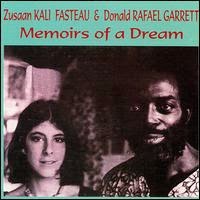
You can count me among the fans of the Sea Ensemble's 1974 ESP-Disk album We Move Together; it's one of the less heralded ESP titles, coming so late, and maybe due to it not really fitting into any prevailing jazz scene at the time. Don Garrett is one of those figures who was integral to the 1960's free jazz movement without being recorded that many times. He played on Coltrane's Kulu Sé Mama and in the Archie Shepp band for a bit, and was generally described as being an energetic, visionary figure who knew and worked with just about everybody, without ever carving out much of a name for himself as a band leader or soloist. His long-term relationship with Kali Fasteau (they were married during the 70s) led to the Sea Ensemble, a duo group that somehow sounds like so much more. I came across this double CD at some point in my exploratory jazz phase and often throw it on when I want to escape into the fluid movement of wind. These are two live concerts, and they are flowing, evocative improvisations. The first disc is live in Leiden, 1975, and in two 15-minute tracks they start a whirling ball of organic sounds rolling that never really stops, though it has its ebbs and flows. It finally comes to a gentle, slow resolution where the air, channeled by these two, finds a resting place. The second disc is live in Turkey, 1977, towards the end of their relationship. This is divided into twelve tracks, all untitled, and has a less crisp, more woody fidelity. They start by speaking an introduction with some abstract language and then blow through some intense interactions. There is a lot of piano and upright bass, as well as the wind instruments heard so prominently on the first disc. The fidelity makes it sound a bit like a recording from the 1920's or at least the pre-modern times; this gives it even more of an otherworldly feel than the instrumentation does. There's a good bit of vocals here, sprinkled overtop like a spice, and the two get into a push-pull thing sometimes, particularly when both on wind instruments (I can't always tell what's what; some of the flute-like sounds feel too wooden in origin to be a proper flute, but then not quite a shakuhachi sound either). When it gets more of an edge (the double-bass bowing is warm and wet, but there's a more sharp, grating bowed instrument later on that when plucked sounds like a sitar or something Indian), it stands out from the other tracks. This musical freedom, where a jazz basis is synthesised with the pulse of worldwide traditional music, feels more like a way of life than a genre. Though many of my favourite 'jazz' artists trend towards this type of output (Alice Coltrane, Don Cherry, etc.), they're really outliers when compared to the standard jazz narrative, of Wynton Marsalis and Lincoln Centre and public radio and all that shit. Maybe this is just a bunch of hippie shit, but these artists found their path and stayed committed and true, and you can hear it between the notes and spaces of the recordings. The passion here is expressive, but it's as much about the overall artistic vision (visually, as well as in the way they lived) as it is about the sounds themselves. I find inspiration here more from that aspect than from the actual recordings, because as pleasurable and psychedelic as it can be to be carried on Fasteau and Garrett's flying carpets, it's more of a call to arms, to get off this laptop and pick up my busted-ass clarinet and start exploring my own outer spheres. That's not to diminish how great this is - it's an hour and a half well-spent, alive and breathing.
Tuesday, 24 December 2013
John Fahey - 'Requia' (Vanguard)
I don't have any Fahey records on vinyl, but would love to find at least America (as it differs from the CD version), as hearing his guitar picking bathed in scratchy, late-60s vinyl atmospherics is surely wonderful. But despite my general dislike of the glass-mastered format, the mastering job on Requia is done right. The first sharp tones of 'Requiem for John Hurt' jump out of the speakers, so clean, and right up against my ears as if they're right over my shoulder. Maybe we're all used to listening to music through laptop speakers now, but this is music that still feels alive, even though it's approaching a half-century mark. Requia is also notable for it's 4-part, musique concrete-laden 'Requiem for Molly', which occupies most of the second half of this album and finds Fahey at his most experimental, at least until Womblife came around in the late 90s. And for those trying to truly understand Fahey, maybe this is the key. The liner notes explain how he started playing guitar in the 1950s but he failed to find the freedom he sought; while not directly relating this sense of constraint to the tape experimentations of 'Requiem for Molly' it's hard not to draw the parallel. As a tape piece, it's all over the place. Sped up loops and voice samples recall Steve Reich's tape work from around the same time; the incorporation of marching bands, funeral music and other earlier American styles, over which Fahey alternates between a mournful chordal progression and more abstracted slide playing and frantic picking, makes a chaotic tapestry that nonetheless retains its appropriate colour throughout. Actually, it makes me feel a bit of the same ur-Americana as Van Dyke Parks' Song Cycle, released nearly the same time. The other tracks on Requia are solid too; 'When the Catfish is in Bloom' is described as a 'cantica' (along with the closing beauty, 'Fight On Christians, Fight On') and it's alcohol-fueled composition, described in the liner notes, makes me wonder if Richard Brautigan was sitting in the coffee shop where it was composed. The cover of this is also wonderful - Fahey looks a bit like a traveling door-to-door salesman, with his tweed jacket and skinny tie. His position is straight-forward, the way a "folk" record should portray him, as he just looks like a nice young man. There's nothing visible here to indicate the far-out sounds on (imagining this is a vinyl original) side two. But they're not actually that far-out. Compared to the forced surrealism of, say, Zappa's earliest work (which we must admit we'll probably never reach in this project) or even After Bathing at Baxter's, the tape collages of 'Requiem for Molly' are naturalistic and even subtle -- making this a musique concrete work that you could play for your grandmother. Especially when it's made by what looks to be such a nice young man.
Monday, 23 December 2013
John Fahey - 'The Legend of Blind Joe Death' (Takoma)
According to discogs.com, Blind Joe Death has been issued 12 times, and what makes it confusing is that Fahey re-recorded parts of it later in the 60s. This is a semi-authoritative release, though it's not for completists, which I'm not. As a document of Fahey's earliest style it's good enough for me. We all know this was a unique invention, an American folk guitar form that was set forth assertively and influenced legions. The blues roots are inevitable; most of the Blind Joe songs follow a 12-bar or similar pattern. But somehow Fahey's playing doesn't raise any of the usual questions about race or authenticity; it's a confident and singular vision that is also flexible. There's a remarkable variety of mood here, from the spare melancholy of 'On Doing an Evil Deed Blues' to the thick, reverberating grandeur of 'The Trasncendental Waterfall', whose length and title alone indicate you're in for a ride. Having listened to a bunch of Fahey in the past, there's a lot of familiarity to the cadences, the pauses, and the sense of motion. When Fahey's own voice introduced the last track, "West Coast Blues', there's something chilling about hearing him so young, especially as my introduction to his work was with his late 90's "comeback" recordings (and the time I saw him live and met him was shortly before his passing). The idea of re-editing an album and releasing it multiple times, making no version truly authoritative, is a radical one. It makes the record feel like a living, evolving work with no necessary endpoint, and that feels somewhat progressive for its time, though I doubt it was its intention. Maybe Blind Joe Death is the Google Docs of acoustic guitar records; additionally, the presentation of the recordings as being by Blind Joe Death could raise all sorts of postmodern questions about authorship, etc. None of which was Fahey's intention, of course, but it's a funny way to reinvent this. And if the man was about anything, it was reinvention.
Sunday, 31 March 2013
Barry Dransfield (Spinney)
It's odd to have this and Nick Drake back-to-back, because I just finished trying to articulate feelings about Nick Drake's legacy as a resurrected-from-obscurity folk icon, and I kept mentioning (without naming) other obscure figures from that time. So here's an example, right away - Dransfield, who pops up on various records here and there (I think I have him playing fiddle on a Shirley Collins album or two, but I'm too lazy to pull them out and check) and then made this, his only solo album, in '72. He plays all of the instruments and thus keeps things spare, mostly built around his strong voice and arpeggiated guitar patterns. It's about half traditionals and half then-contemporary covers, opening with Michael Hurley's 'Werewolf' and David Ackles' ''Be My Friend' as a one-two punch. I like both songs - my appreciation of Ackles has been mentioned in these pages before - but his Apollonian treatment of 'Werewolf' pales in comparison to the Holy Modal Rounders, a version I love so much I can't even accept Hurley doing it anymore. The traditionals integrate fairly well with the newer songs, as the production links them consistently. It's a good album, though a bit distant - 'She's Like a Swallow' tries but fails to really impact through his vocal delivery, but it's too rigid to have the compassion it needs. Perhaps an album built entirely from overdubs lacks responsiveness, though there are other examples of this working for me (Roy Wood's Boulders! - to be reviewed on this blog in about 20 years). And on the instrumental medley jam 'Reels', things sound great, and Barry works into a jig-like frenzy. There's nothing to tie this to the electric/rock side of early 70s British folk revivalism, but that might be a benefit - Dransfield is clearly a traditionalist and he sticks with what he knows. I think I bought this when it was reissued because that coincided with a peak of my interest in this stuff; now I'm less moved by it, but there's something so pleasant about his voice and guitar -- so it stays on the shelf collecting dust, inspiring the occasional listen.
Monday, 27 July 2009
Atman - 'Tradition' (Drunken Fish)
"Featuring Anna Nacher", whose vocals are all over this thing, this Atman album buzzes and howls through the dark Polish woods, years before Dead Raven Choir. Where renmant ghosts of Nazi tanks still remain, melting voices from the spiritworld blend with rampant ethnoacoustics. There's a Hendrix cover and a bunch of crazed shoutingYELPINGmuttering, lotsa instruments you don't know the names of, and a general woodland vibe. Sixty-three minutes of it, too! But like future band the Magic Carpathians, that forest atmosphere is taken into a recording studio and all the tricks are in place. There's a funky electric bass, some synths, and a general layer of gloss over everything. This pagan approach to psychedelic music, with the rock all sucked out, surely influenced all those bands in Finland that came along later. Except that while those bands used lo-fi hiss to make their sound more otherwordly, distant, etc., Atman seem cool with the idea that music can actually be well-recorded; thus if you are so inclined (and have nice high-quality speakers or headphones and stereo audio equipment) you can really lose yourself in the joy of recorded instruments. The pure, inherent psychedelia of a reverberating string is on display here, though layered and with madcap vocals threatening to distract. The whole "other" aspect of the Polish language gives Tradition an air of exoticism to this native-English speaker, though maybe they're just singing about girls, fast food and cars. Ten years ago, when I got this CD, it was like discovering a new world of insane atmospheres, and from my ancestral homeland as well! But listening now, it feels less impressive; maybe because I've got another decade of hearing similar sounds, some predating Tradition by 20 years or more. But maybe I've just moved further into my own; the pagan thing carries nothing exotic anymore, I've been to Poland now, and my tastes have moved away from crazy folk-based psych. And maybe I demand something a bit more concise now; 63 minutes is a lot of Atman, where 40 might have sufficed. But not to be hard on this - as I haven't listened to this for a few years it was a pretty nice flashback.
Subscribe to:
Posts (Atom)


