HEY! Get updates to this and the CD and 7" blogs via Twitter: @VinylUnderbite

Showing posts with label live recording. Show all posts

Monday, 15 September 2014

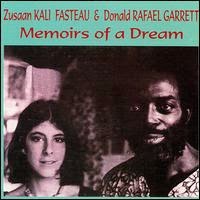
Zusaan Kali Fasteau & Donald Rafael Garrett ‎– 'Memoirs Of A Dream' (Flying Note)

You can count me among the fans of the Sea Ensemble's 1974 ESP-Disk album We Move Together; it's one of the less heralded ESP titles, coming so late, and maybe due to it not really fitting into any prevailing jazz scene at the time. Don Garrett is one of those figures who was integral to the 1960's free jazz movement without being recorded that many times. He played on Coltrane's Kulu Sé Mama and in the Archie Shepp band for a bit, and was generally described as being an energetic, visionary figure who knew and worked with just about everybody, without ever carving out much of a name for himself as a band leader or soloist. His long-term relationship with Kali Fasteau (they were married during the 70s) led to the Sea Ensemble, a duo group that somehow sounds like so much more. I came across this double CD at some point in my exploratory jazz phase and often throw it on when I want to escape into the fluid movement of wind. These are two live concerts, and they are flowing, evocative improvisations. The first disc is live in Leiden, 1975, and in two 15-minute tracks they start a whirling ball of organic sounds rolling that never really stops, though it has its ebbs and flows. It finally comes to a gentle, slow resolution where the air, channeled by these two, finds a resting place. The second disc is live in Turkey, 1977, towards the end of their relationship. This is divided into twelve tracks, all untitled, and has a less crisp, more woody fidelity. They start by speaking an introduction with some abstract language and then blow through some intense interactions. There is a lot of piano and upright bass, as well as the wind instruments heard so prominently on the first disc. The fidelity makes it sound a bit like a recording from the 1920's or at least the pre-modern times; this gives it even more of an otherworldly feel than the instrumentation does. There's a good bit of vocals here, sprinkled overtop like a spice, and the two get into a push-pull thing sometimes, particularly when both on wind instruments (I can't always tell what's what; some of the flute-like sounds feel too wooden in origin to be a proper flute, but then not quite a shakuhachi sound either). When it gets more of an edge (the double-bass bowing is warm and wet, but there's a more sharp, grating bowed instrument later on that when plucked sounds like a sitar or something Indian), it stands out from the other tracks. This musical freedom, where a jazz basis is synthesised with the pulse of worldwide traditional music, feels more like a way of life than a genre. Though many of my favourite 'jazz' artists trend towards this type of output (Alice Coltrane, Don Cherry, etc.), they're really outliers when compared to the standard jazz narrative, of Wynton Marsalis and Lincoln Centre and public radio and all that shit. Maybe this is just a bunch of hippie shit, but these artists found their path and stayed committed and true, and you can hear it between the notes and spaces of the recordings. The passion here is expressive, but it's as much about the overall artistic vision (visually, as well as in the way they lived) as it is about the sounds themselves. I find inspiration here more from that aspect than from the actual recordings, because as pleasurable and psychedelic as it can be to be carried on Fasteau and Garrett's flying carpets, it's more of a call to arms, to get off this laptop and pick up my busted-ass clarinet and start exploring my own outer spheres. That's not to diminish how great this is - it's an hour and a half well-spent, alive and breathing.
Sunday, 11 May 2014

Fairport Convention - 'House Full' (Hannibal)

Here's one I got for free somehow, which is a live recording of the 1970 Fairport lineup, post-Lamble, post-Denny. Just five guys trying to make the best of their iconic vocalist's departure. The liner notes, written by Joe Boyd in the 60s, are somewhat dismissive of the Full House album and of later Fairport in general (referring to a 'long, slow, sometimes ungraceful but always spirited decline'). But he insists that this 1970 band was a tight unit, not captured on the studio recording, and thus this live gig from Los Angeles in September 1970 is presented to support his argument. It's a good live recording - a bit lacking in the low end, but this is a CD after all - and the 'reluctant vocalists' Thompson and Swarbrick (again, Boyd's words) sound pretty confident to me, especially on 'Banks of the Sweet Primroses' where they exude a casual confidence which sounds striking, or maybe I just like English accents. The band is overall playing a bit fast, or at least with a spring in their step. The instrumentals are particularly fierce - 'Mason's Apron' sounds like something off Camper Van Beethoven's second album, and the climax of 'Matty Groves' never sounded better. As a band, the material has shifted really strongly towards the 'folk' in 'folk-rock' (which is a nice juxtaposition with the Heyday CD we just listened to) and also leads to more extended meandering solos by Thompson, which are always welcome. He seems to just stick some extra notes in hidden places, here and there, and it's a casual grace that he masters when he starts making solo records a few miserable years later. The centerpiece, of course, is 'Sloth' - I've already proclaimed my love for this song elsewhere, and that remains on this version, if it isn't amplified. The fierce buildup about 8 minutes in is even more aggro than the studio version, and the raw live edges are perfect for the come down, when Swarbrick starts to delicately pluck the violin strings around the cadence. It's like he's trying to tease the beast of a melody into revving up again and it works wonders. I love this song and even though this lineup of Fairport is slightly lackluster,  I can't imagine 'Sloth' with Sandy Denny -- the sense of resignation and frustration is distinctly male. The closing cut, 'Battle of the Somme', is delicate in a way that it feels out of place, especially after 'Mason's Apron', but maybe that's just my own itchy nervousness coming into play.

Tuesday, 2 April 2013

Dream/Aktion Unit - 'Blood Shadow Rampage' (Volcanic Tongue)

With gatefold-CD artwork painted to recall the "video nasties" of the 1980s, Blood Shadow Rampage sets its aesthetic loud and clear before the disc even starts. Consisting of Thurston Moore, Heather Leigh Murray, Chris Corsano, Matthew Heyner and Paul Flaherty, it's totally twisted and free, as you'd expect. But it's not just a big ball of noise - there are improvising musicians, not in-the-red noiseniks (for the most part) and there are some really sparse comedowns, particularly during 'Your Missing Foot' and 'Brutal Lust'. Corsano and Heyner are an interesting pairing and they serve to really make this recording distinct from other Corsano/Flaherty projects - they often hold back, playing around rhythm  and letting the unusual assonance of Moore and Murray's strings create what are sometimes quite psychedelic toneclouds. It's not always clear to me what's Flaherty, what's Murray, and what's Moore, especially when there gets to be more high-pitched frequencies. But there are moments, such as on the closing track ('Here Come the Fucking Dead') where Flaherty amps up the vibrato and there's no doubt you're listening to a saxophone. You can get a sense of the musicians pushing and challenging each other, and there are moments that scream against the identity of free music, with the swirling gasps of feedback and other tinnitus-enhancing treats. When Corsano does kick in, it's often cathartic, and Moore (whose guitar is the most elusive animal here) occasionally steps in to remind you that, yes, he's Thurston Moore. This is a live recording from Stirling, Scotland and the crowd responds appropriately. 

Monday, 25 March 2013

Double Leopards - 'Savage Summer Sun' (Hospital)

When we last left Double Leopards it was with Halve Maen; fast-forward a couple years and we get this digitised slice of two live performances, filling the CD's 73 minutes and being relentless in its deep, rumbling drones. Here, we can see the progression of the band as a collective unit, where four humans create an abstract sound-world. They weren't the first to do it, nor were they the last, but they hit on something unique and personal during the mid-00s which is commendable (despite spawning legions of imitators, which isn't their fault). The first track begins with a wall of low frequencies, during which we start to hear screaming, free-jazz styled noodling emerge over a slow, military-like rhythm. It's still subdued by the density that fills the midrange spectrum,  which gradually allows a razor-sharp counter-drone to fight against it. Movement is slow, and change almost imperceptible, but there's a brash charging forward felt here - I would even call it 'energy'. It's not an obvious melting of like-minded improvisers but rather distinct personalities, united in some goal, though of course the unconventional instrumentation (I am guessing lots of processed voice, homemade synthesisers  and keyboards) means this could all be the work of a single person.  And then the second track begins with a full-on assault, with layers suggesting water, metal, and ruptured velocity. It's anti-meditative drone music, yet horizontal enough to be based on some minimalist heritage. It's a live performance and the rough edges are present; some percussion comes and goes but resembles a fumbling in the rumbling; not a bad thing, and this instability presses against the endless cycles. And when it ends, it's the silence that is savage. Thus we bid Double Leopards farewell, though I swore I had more recordings by them -- whatever happened to my vinyl copy of A Hole is True?