HEY! Get updates to this and the CD and 7" blogs via Twitter: @VinylUnderbite

Showing posts with label tidal gravity. Show all posts

Monday, 15 September 2014

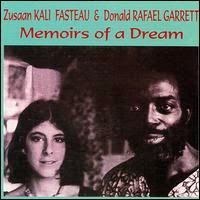
Zusaan Kali Fasteau & Donald Rafael Garrett ‎– 'Memoirs Of A Dream' (Flying Note)

You can count me among the fans of the Sea Ensemble's 1974 ESP-Disk album We Move Together; it's one of the less heralded ESP titles, coming so late, and maybe due to it not really fitting into any prevailing jazz scene at the time. Don Garrett is one of those figures who was integral to the 1960's free jazz movement without being recorded that many times. He played on Coltrane's Kulu Sé Mama and in the Archie Shepp band for a bit, and was generally described as being an energetic, visionary figure who knew and worked with just about everybody, without ever carving out much of a name for himself as a band leader or soloist. His long-term relationship with Kali Fasteau (they were married during the 70s) led to the Sea Ensemble, a duo group that somehow sounds like so much more. I came across this double CD at some point in my exploratory jazz phase and often throw it on when I want to escape into the fluid movement of wind. These are two live concerts, and they are flowing, evocative improvisations. The first disc is live in Leiden, 1975, and in two 15-minute tracks they start a whirling ball of organic sounds rolling that never really stops, though it has its ebbs and flows. It finally comes to a gentle, slow resolution where the air, channeled by these two, finds a resting place. The second disc is live in Turkey, 1977, towards the end of their relationship. This is divided into twelve tracks, all untitled, and has a less crisp, more woody fidelity. They start by speaking an introduction with some abstract language and then blow through some intense interactions. There is a lot of piano and upright bass, as well as the wind instruments heard so prominently on the first disc. The fidelity makes it sound a bit like a recording from the 1920's or at least the pre-modern times; this gives it even more of an otherworldly feel than the instrumentation does. There's a good bit of vocals here, sprinkled overtop like a spice, and the two get into a push-pull thing sometimes, particularly when both on wind instruments (I can't always tell what's what; some of the flute-like sounds feel too wooden in origin to be a proper flute, but then not quite a shakuhachi sound either). When it gets more of an edge (the double-bass bowing is warm and wet, but there's a more sharp, grating bowed instrument later on that when plucked sounds like a sitar or something Indian), it stands out from the other tracks. This musical freedom, where a jazz basis is synthesised with the pulse of worldwide traditional music, feels more like a way of life than a genre. Though many of my favourite 'jazz' artists trend towards this type of output (Alice Coltrane, Don Cherry, etc.), they're really outliers when compared to the standard jazz narrative, of Wynton Marsalis and Lincoln Centre and public radio and all that shit. Maybe this is just a bunch of hippie shit, but these artists found their path and stayed committed and true, and you can hear it between the notes and spaces of the recordings. The passion here is expressive, but it's as much about the overall artistic vision (visually, as well as in the way they lived) as it is about the sounds themselves. I find inspiration here more from that aspect than from the actual recordings, because as pleasurable and psychedelic as it can be to be carried on Fasteau and Garrett's flying carpets, it's more of a call to arms, to get off this laptop and pick up my busted-ass clarinet and start exploring my own outer spheres. That's not to diminish how great this is - it's an hour and a half well-spent, alive and breathing.

Monday, 8 April 2013

Earth - '2' (SubPop)

I'm no stoner and thus I never got hip to the whole wave of bands like Sleep, Sunn O, Corrupted, etc. Not that I dislike the style - these pages will show I'm no stranger to minimal epics, heavy guitars, and glacially-paced records. I guess it's the rock edges that always got me - I'd rather trance out to a Terry Riley or Phill Niblock monolith than feel the residue of heavy metal, or whatever I imagined is there. But like most genres I have one or two entries on the shelves, and this Earth 2 CD is one I very much treasure, because it out-stoners all the stoner rock I've ever heard, and isn't really rock. It's just guitar and bass, often imperceptible from each other, in three very long tracks, with not much changing. It's the record I think Earth's reputation rests upon, or should rest upon, as it's an almost unparalleled statement especially given the time (1993) and label (SubPop, post-Nirvana)! The value in here is not just the sheer immobility of it, because there's actually quite a lot of motion and genuine riffs that return, too - but in the overall atmosphere. Put on Earth 2 and you'll spend the next 70 minutes trapped inside a spherical chamber over which you have no control of your senses. It works quietly as ambient music and it works very loud too, because there's a lot of magic happening in these guitars. 'Teeth of Lions Rule the Divine' feels unending cause it is, but there's a small universe of swirling, buzzing atmospherics on top. And the final cut, 'Like gold and faceted', is over a half-hour with some crashing percussion in the background here and there (but not too much) and it's essentially an endless slow roar. It's exactly like the time I saw Tony Conrad play live, except a meathead version. Meathead minimalism is great, though! Who cares if they have the history of 20th century composition under their belts (and maybe they do)? If Carducci taught me anything it's that intellect has no bearing on great music. These guys are still around but they reinvented themselves as a post-rock band with British folk leanings, and what I heard I really liked; but this is something special, something so simple it's actually quite difficult. 

Tuesday, 21 February 2012

The Dead C - 'DR503C' (Flying Nun)

We're a bit overrun with early Dead C here, and this CD overlaps significanty with the Ba Da Bing reissues we already addressed on the Vinyl Underbite blog. But that's okay, because there's some differences here, though I must admit my head hurts too much (from too many adjacent versions of 'Max Harris') to determine precisely what is the overlap and what is unique here. I'll take a different sequence as reason enough to keep this CD, even though the sound quality doesn't compare to the 180g love that Ba Da Bing gave us. 'Crazy I Know' and 'Speed Kills' start things off, perhaps a decision by Flying Nun to want this CD to at least tangentially resemble other releases on the label, at least for those lazy reviewers who only look at the first few tracks. 'Polio' and 'Max Harris', in all of their lo-fi glory, are the length game here and some parts of The Sun Stabbed are here, though the version of the title track is live (and unique to the CD, for sure).  I've already gushed my unequivocal love for this material when I listened to them on vinyl last week, so I have little to repeat here. I will say that 'Bad Politics' wasn't as enjoyable the fourth time through (cause I listened to the vinyl copies multiple times) but 'Fire' more than makes up for it. I don't know if Ba Da Bing is finished with their reissue programme or if they're gonna delve into the Siltbreeze years -- a vinyl edition of Harsh 70s Reality is a MAJOR hole in my life -- but if they do, they should try to scoop up whatever is left.

Sunday, 29 January 2012

Moniek Darge - 'Soundies' (Kye)

Sound art or music?  It's an eternal dilemma; I have vacillated between positions myself, it's certainly easy to group Darge's work into the 'sound art' category.  Especially when presented as Soundies is, a compilation subtitled "selected work 1980-2001", with a list of which sources each recording is culled from. But I want to treat this as music.  If there is a difference, to me, it's in expression and intent.  Darge certainly is interested in the pleasures of listening, but I feel there's a lot of life in the little spaces of this CD. It's an array of fun, including voice, clarinet, violin, "musical objects", harp samples, slides, and "performance"; the resulting tracks vary but all maintain a strong emphasis on detail.  The longest track is the opening, from 1980, 'Sand'; it takes it's time to develop, suggesting the anti-music structures of Anton Bruhin in places, but is not bogged down by it's own conceptualism. As her work progresses (with a 12 year gap between 1983's 'Fairy Tale', my personal favourite, and 1995's 'Harpje', my second favourite track) Darge seems to be more interested in how things layer.  There's a soundscape feel to her late 90's work, partcularly 'Caete' which drapes wind and sea waves over clusters of small sounds. Darge's pieces feel organic and not too carefully meticulous, which keeps them closer to the underground than to the museum, always a good thing. The vocal work is inspiring at times, sometimes leading the pieces into a narrative feel. Her editing style is not as simple as saying 'cut-up', but there's a discordance and motion that always orbits around direction. It's a long disc, as a good archival release should be, and is understandably more varied than her Sounds of Sacred Places recordings, which are beautiful in their own way. I never seem to get tired of music like this, which draws from my own interest in abstract/surrealist sounds - and of course, the unending influence of the NWW list in my life. Darge is too late for that list but clearly comes from similar mental space.  

Friday, 29 October 2010

Cerberus Shoal - 'Bastion of Itchy Preeves' (North East Indie)

With excesses in check, this is the Cerberus Shoal record I was waiting for, quite literally for years. The live band that I saw in 2000 or 2001 was a really mystical, strange creation that somehow touched on things antiquated and historic, yet was obviously innovative and forward thinking. And while this was released after Chaiming, they started recording it in 2001 and just took ages to finish it. Bastion of Itchy Preeves is another 70+ minute disc, but this time it's split over ten songs. There's a strong reliance on xylophones or steel drums, making tracks like 'Bogart the Change' resemble a mutant Talking Heads. Flutes and recorders are so integrated into their sound at this point that it's barely noticeable - just part of that whole Cerberus Shoal thing, y'know? And vocally, there's some beautiful, haunting harmonies - the chant of 'Baby Gal' with it's sharply over-enunciated inbreaths is pure Edward Gorey. The songs tend to open up more, and they aren't afraid to build up thick drones and occasionally erupt, but there's less of a need to have thunderous post-rock structures behind everything. And the humour is far more restrained which can be a good or a bad thing depending on your personal take. 'Grandsire' opens things up with a thick rolling blanket of pure tonal bliss, a strong post-Homb step towards melodic convergence. There's sample voices, processed through damaged electronics, but only as icing on the cake - the core of all of these songs is the notes, rhythms and voices generated by very human hands. I think my enjoyment of Itchy Preeves is somehow set by the artwork, a monochromatic modification of a TV schedule -- it conveys something antediluvian, but clearly contemporary - a true hodgepodge of sensory juxtaposition which is probably the best way to describe Cerberus Shoal. But I go into this disc with a certain mentality that's much more austere than the technicolour Chaiming. I mean, there's still elements of Chaiming's goofy, art-rock cocktail here. It's most notable on 'Tekel Upharsin', I think. That track builds up around around a repetitive, circular bassline, with notes slipping around on their intonation in a way that somehow reminds me of uber-primitive synth work. Over this various ethnic stringed instruments pluck out a melody, along with accordion and violin, and then group singing that's like a mentally insane village party, but without any trace of Wicker Man-style tones. It feels a bit like being stuck in a chicken coop at parts. A lot of Itchy Preeves falls into neo-prog territory, though the band is far more focused on textural exploration than displaying chops or composing complex song structures. The closing track, 'A Head No Bigger Than a Man's Cloud', takes on a Cocteau-like atmosphere with it's undecipherable, breathy vocals, and a twee music box dances overtop of the things. It's almost distracting from the gentle tide that lies underneath, making this a lovely finale.