HEY! Get updates to this and the CD and 7" blogs via Twitter: @VinylUnderbite

Wednesday, 30 January 2019

The Franciscan Hobbies - 'Walls Are Stuck' (Music Fellowship)

Sometime around 2005 I blinked and when my eyelids came back up, there was a ton of music being made that sounded not unlike the Franciscan Hobbies, a large ensemble connected to that small collective of bands in the Bay Area vicinity known as Jewelled Antler. Glenn Donaldson and Loren Chasse are both credited here and I'm not sure exactly how involved they were - full leaders, perhaps, or just bit players - but the sound of the Hobbies comes from the same open, melodic air that other Jewelled Antler bands (such as the Child Readers, Thuja, and the Blithe Sons) occupied. In fact, if you played any of those bands to me I'd struggle to tell them apart, but I suspect the musicians in these groups, which largely overlapped, wouldn't feel differently. The band names just become another form of organising the sound-image, just like the album name and titles of the songs, maybe? Anyway, Walls Are Stuck is an all-instrumental play-around in this soundworld, driven by largely acoustic instrumentation and lo-fi recording technologies. There are electroacoustic elements but only in the sense of a dictaphone tape warp (on 'Empty Hands', which is a lovely bit of concrete, using a decayed violin riff, which dissipates before wearing out its welcome) or delicate keyboard tinkles, dancing over the pulse (the sublime 'The Happy Burial'). There's usually some tape hiss or room vibe in the background, the sound of people walking around, instruments being picked up and put down, and an outdoor feel for very much of it. It's what I think of as the Jewelled Antler sound, one that has largely faded as the more pop-orientated projects of theirs (Skygreen Leopards, the Lovebirds) have become more serious, but one that I have a soft spot for because these are incredibly beautiful records to lose oneself in. The jams are obviously jamming, but when you listen to a track like 'Asmodeus', where different stringed instruments are plucked and bowed, the interplay is tentative and egoless, building up a common sculpture that is calming but not simple. Over in the UK at the same time, the Vibracathedral Orchestra was making a real clatter, similar in many ways (harmonic overtones, no central riff or show of musicianship, a sense of wonder) but still somewhat more attenuated towards a common pulse. The Franciscan Hobbies reject the easy groove and elevate the texture to the forefront. The result is lovely, and welcoming.

Sunday, 10 December 2017

Flying Saucer Attack - 'Further' (Drag City)

Right about now feels like the time that Dave Pearce's music is due for a comeback, not that he ever went away, or became unfashionable. He just became less prolific, and seems a million miles away from any sort of music scene politics these days, still making music how he wants and releasing it now and then (the last being the Instrumentals 2015 record which I have not heard yet). I remember reading about Flying Saucer Attack in zines and other pre-Internet media in the early 90s; reading one particular publication, the name of which I can't remember, it seemed (to me) that FSA were aggressive sci-fi space-rock, as they were reviewed alongside more punk-orientated material. My teenage mind couldn't handle that type of diversity yet, because when I finally got around to hearing them (these were the days where one had to struggle to actually hear the things one read about, especially on a high schoolers budget) I was disappointed; it sounded too abstract, too empty to me. Of course that changed later on, once I started to investigate minimalism and drone, and to make my own music which wasn't a million miles away form this sound. Further is probably now the record of theirs I appreciate the most, as it feels like the best balance between all of FSA's various tendencies (folk song vs drone piece, harmony vs dissonance, lo-fi vs hi-fi). Owning it on CD gives it a glassy shimmer, and on a track like 'For Silence', which moves between all of these tendencies, I can only imagine how it must sound coming from vinyl's dynamic range. Acoustic guitars are dominant, and there's quite a lot of arpeggiated picking, making this more obviously folk-based than I was ready for as a teenager. Listening now, I can really hear the saturation in British traditional music, even if 'To The Shore' sounds more like Labradford than Shirley Collins. This reinvention of British folk form was something else totally lost on me not just as a youngster, but later when I discovered and really fell in love with FSA; it's only now that I really feel this is truly the next step in a lineage. Rachel from (the wonderful) Movietone was still a core part of the band here and her voice on 'Still Point' creates a spooky ambience that most directly recalls the strong tonality of the British female voice; that the song is drenched in delay and reverb doesn't inhibit this comparison, but if anything amplifies it. This is music that can be taken in peripherally, as a semi-ambient bouquet of suggestions, or full-on direct into the centre of one's skull. 'In the Light of Time' and 'She is the Daylight' function perhaps as the two anchors of this record, both built around Pearce's earnest voice, over delayed arpeggios, the mildest percussive elements (just tapping the guitar body, I think) and then the bright light tones that drift overtop, like the album artwork rendered into sound. This music has aged very, very well, and the close connection I feel to my physical body when listening to it separates it from that which is based in trends or the cultural context of the time. It's easy to lose oneself in this record, and somehow it feels short even though it's 'proper album length'. 

Tuesday, 7 November 2017

Flop - 'World of Today' (Frontier)

And here the Flop story ends, and it couldn't happen in a more beautiful and fiercely contemplative manner. Actually, if we're talking pure aesthetics of sound, World of Today only slightly pulls back the big, loud hard rock sound of Whenever You're Ready; the grandiose, stadium rock riffage is still here, recorded like a brisk autumn wind, and on this November morning I couldn't think of a more suitable record to listen to while watching the grey sky slowly brighten. World of Today was released after the band broke up, back on the Frontier label, and is a rare album that I prefer to have on CD than vinyl, since it was squeezed onto a white 10" that is mastered terribly. Maybe someday it will get repressed with the extra 2"s that it deserves, but I'm going to have a slow campaign of winning over fans to Team Flop until then, to build the potential market. Oh, capitalism - if there was justice in the world, then every man, woman and child on earth would receive a 12" 180g vinyl pressing of World of Today in their postboxes tomorrow, and together we could start to understand the frustrations and resentments of mankind, collectively. Because this is an album that is very much about the torment of the individual, struggling to acclimate through schooling ('North Mason Middle School'), child-parent relationships ('Eggs and Ash'), post-adolescence ('Of Today'), childbearing ('April Ate Our World'), labour (the brilliantly existential closing cut, 'Two Martians Working', as perfect a coda as could be) and escapism ('Waste of Space'). If this sounds like a bumpy journey, well it's true that World of Today is less accessible than And the Fall of the Mopsqueezer. The only single was the opening cut, 'Act 1, Scene 1' which is a dark, existential rumination on the corporeality of being, and sets the tone for what is to come. There's unmistakeable darkness throughout this record, and you can hear it in Willoughby's voice - it's hitting a slightly higher register, and there's none of the exuberance heard before on songs such as 'The Great Valediction'. That's not to say he underperforms here - in fact, there's still an enthusiasm and joy for music, and exhibit A of that would be the cover of 'Yellow Rainbow' by the Move. This is a remarkable rendering of an already remarkable song, and the 60s acid imagery of the original takes on a malevolent tone with mid 90s guitar production behind it,  and in the context of the rest of this album. Yet throughout, the essential fairytale nature of the song is never lost as Willoughby sings with almost reckless abandon. If I'm making this out to be a dour, miserable trip, then I'm doing a bad job of conveying the pure joy (no pun intended) of World of Today, at least as a listener. The catchy hooks and musicianship are more integrated than ever before, and you get delicate guitar jangle ('Eggs and Ash' is a beauty to listen to with Kurt Bloch's production) and shifting time signatures ('Of Today'), as well as some of the most earworm-forming (albeit dark) lyrics imaginable. Imagine a fifteen year old version of me singing 'You'll get more disillusioned with age ... you wait!' alone in my bedroom. (In case you're wondering, he was right, I did. We all do, which is one of the lessons of World of Today). This record represents the peak of Willoughby's songwriting in Flop, and some of the most personal moments that I've discerned from his work.  Hell, it represents the peak of songwriting in general, from just about anyone. It's hard to pick a single highlight but maybe it's the penultimate track, 'Miniaturize', which begins with a masterfully epic jangly buildup before it's autobiographical raison d'ĂȘtre is delivered with such mastery that I wish stadiums and arenas were filled with thousands singing along: 'Solemn as a child / in stoic reticence'. The melodic high point may be the back-to-back punch of 'Around' and 'We've All Seen Better Days', the latter being one of the moments of relief and empathy that comes here. I  can only wonder about the residue of failed relationships here, as well as a general questioning of one's purpose in life. That this came out of the Sony-catalysed bad juju makes sense, and if it's a band falling apart then it's channeled through one man questioning everything. I meant to post this a few days ago but once I started listening to it I kept listening to it over and over, so I've listened to this about ten times in the past week and just want more, and I've been listening to it consistently since 1995. I've never met another Flop fan in person, and only a few people who remember them at all; certainly no one whose life was so affected by this record as a teenager. I realise that there's a lot of great records that had I invested my formative years into them might have impacted me as much as this one, but I'm glad I ended up with this one being so important.

Wednesday, 1 November 2017

Flop - 'Whenever You're Ready' (Sony 550/Frontier)

Are you ready for a hot take? Here goes: Rusty Willoughby is one of the greatest unheralded songwriters currently alive, and his best work stands up against the best work by Dylan, Neil Young, Joni Mitchell, Roy Harper or anyone else you might want to put in that canon. And that best work, for me, falls squarely within the boundaries of the three albums recorded by Flop in the mid-1990s. Unfortunately I only have And the Fall of the Mopsqueezer on cassette, which lies outside of the purview of this blogging project, so we must start here with their major label debut-swansong, Whenever You're Ready. The story of Flop, whenever it is written, which is rarely, is always the same - being from Seattle, they got signed to a major label in another case of right-place-right-time syndrome, this being one of the more crippling examples. They recorded this stunner of a second album for Sony, but because the major majorly fucked them around w/r/t promotion and marketing and general support (Steve Albini is always right!), the band collapsed in a mess of bad vibes and their third album, originally meant for Sony, went back to their first label, Frontier. We'll get there soon enough – oh, hooray for it being Flop Day on this blog! Willoughby's previous and future band was Pure Joy, who are also great, and fell somewhere in-between the Paisley Underground sound of Rain Parade/Game Theory and the crunchier melodic punk of Fastbacks (for whom he briefly played drums). For Flop, he brought in Bill Campbell on second guitar and the sound thickened immediately, especially on this record - er, sorry, CD. Campbell's guitar lines do a lot of chugga-chugga and pickslides and things that you hear on metal records, though it's not metal in the slightest; but it's hardly soft rock either, despite the acoustics of 'Parts I & II' or the psychedelic residue throughout. Generally, the production here is thick and booming, which is evident from the kicking drums on the opening 0:01 of the disc; one would situate this closer to the 'hard rock' genre than pop-punk were it not for Willoughby's angelic, soaring voice and the incredible hooks in his songs. Instead, Flop ends up in a maligned liminal zone which was doomed, even for the time; too heavy for radio play, too brainy for the heavy scene. But the songs are sophisticated, sometimes beyond belief;  that opening cut ('A. Wylie') is about An Unsocial Socialist by George Bernard Shaw, so that indicates from the get-go that this is a far cry from whatever Mudhoney and Tad were writing about at this time. Second cut 'Regrets' mixes beautiful poetics ('And the leaves are convalescing / the sun is warming the baby seed') with verses of urban alienation over palm-muted heavy rhythm guitar. Willoughby's lyrics often implicate scientific/medical imagery (though more so on the later Pure Joy recordings) and mix in just enough pop culture references to conjure songworlds that are relatable while just ambiguous enough to create intrigue. A cursory listen may suggest this is merely a competent punk-pop album, a product of its time, but it's so much more. And maybe the competing tendencies of Willoughby and Campbell make the music so much more interesting; the sinewy guitar lead underneath the driving speed of 'Eat' gives it a catchy, clear direction; the production of 'A Fixed Point' makes it sound like if 'The Ballad of John and Yoko' needed its batteries changed; the back-to-back punch of 'Night of the Hunter' and 'Port Angeles' is an experience of pop perfection. The former has some of the most clever and quotable lyrics of Willoughby's career ('Solvents, glue and heroin/ she said "I don't want to do that at all" - and it's a song about the Robert Mitchum movie through and through!) and the latter explodes family tension with religious imagery. Legendary UK producer Martin Rushent engineered this and for me, as a 15 year old, I didn't initially glom onto Whenever You're Ready as quickly as the other two records, maybe because the production felt so heavy. But now I can't imagine this any other way. There's hardly anyone around who remembers Flop and probably even less as passionate about them as I am, but I urge you to investigate these three records, because for over 20 years they've been  endlessly rewarding and get better with age. The same can't really be said for the weirdly retro artwork, though again, I can't imagine this record looking any different by this point in my life - a life that has been mostly lived with Flop as some part of it.

Saturday, 28 October 2017

Faust - 'Rien' (Table of the Elements)

Table of the Elements – now that's a great label, one that managed to make the compact disc form beautiful and desirable, while emphasising an axis of musical experimentation that embraced the past and present. And what could be a better fit for that aesthetic than Rien, the 1994 'comeback' album from Faust, or at least two of the members. This is a fucking impressive collection of dark juju improvisations, with a few guests (Michael Morley, Keiji Haino, and Steven Wray Lobdell so that's an impressive mix of guitar gods, too) and a thick, spacious roar that burns throughout (even during the quiet parts). While the classic Faust albums all had some sort of songforms present here and there, this abandons that in favour of pure horizontal sound painting. This rages with a focused intensity, hardly the sound of nothing as the title indicates, and it moves in often spellbinding ways. This is still, at times, rock music; the long jam whose title is just symbols is built around a pounding drumbeat and has some vocals, chanting 'listen to the fishes' (which makes sense given the symbols); it's the most Faustesque track, the link to the 70s, as there's that ragged kosmische structure that provides a basis for mega-psychedelic layers on top. The last few minutes gel into a high-level drone piece, where the industrial basis emerges; losing oneself in this is a quarter-hour well-spent. There's a heavy sense of dynamics throughout Rien; 'Eroberung Der Stille, Teil II' spends its first half building up around layers of metallic scraping, until the bottom suddenly drops out and allows space for a new, nocturnal malevolence to emerge, with a guitar/theremin interplay that screams for understanding but offers none. The second track, '?', likewise drops to nothing near the end and with a sudden straining to make out detail, attains transcendence. Closer 'Eroberung Der Stille, Teil I' builds a foundation before turning, as if to look at adjacent scenery, and finding a conclusion in some neoclassical strings, melodic yet uneasy. Rien may or may not be classic Faust – I'm not sure how to grasp the lineage of the band, since the original was a market-based assemblage by a marionette-pulling producer, and was always implied to be a freeform collective anyway – but it's a fantastic accomplishment, a very different flavour to the 1970s records but as rewarding. There's still the same sense of the studio as instrument here, which maybe is thanks to Jim O'Rourke's production; it's hard to know what he contributed and what was the vision of the musicians, but a perfect balance is felt between live instrumentation and creative editing. The bilingual, spoken credits at the end remind me of old Robert Altman films, and that's sort of controlled chaos is a nice metaphor for Faust's greatest work, which this definitely ranks up there with.

Faust - 'Seventy One Minutes Of...' (ReR)

Usually if the duration is in the title, I find the task of listening daunting. Maybe that's the reason I never gelled with Seventy One Minutes Of Faust, which is really a combination of their last LP Munich & Elsewhere with some 70s-recorded miscellany, released much later. This hodgepodge lack of cohesion is also part of the problem - even though there's some great, zany art rockin' at play here (the blown out "Baby', or 'Don't Take Roots'), it's certainly not a coherent, self-standing statement like So Far or IV. And the presentation is murky and confusing - the titles are even hard to read on the back of the CD, the artwork rote and uninspiring. It feels a bit like the Faust version of Incesticide, scraping the barrel for completists, at least before their 90s reunion and subsequent split into two competing strains of Faust. Listening today, it's a lot better than I remembered it being, though there's no classic cuts, and the fact that there are seven tracks named 'Party' makes it hard for any to be memorable. These 'Party' tracks are actually the stronger material, though I'm not sure how many of them were intended for release; the fidelity is very crisp (the electronics on 'Party 1' float above the gurgling improv swamp, sounding like something from a more contemporary electronica-indie scene) and they just feel a bit jammy, even for Faust. There's some alternate versions of known Faust commodities; the first 'Party' is a slower take on the song from the beginning of Tapes, with a really nice layer of spacey guitar that brings this into Cosmic Jokers territory. 'Party 5' sounds like British art-rock, maybe some post-Art Bears RIO band. The closer, 'Party 4', includes everything and the kitchen sink (and lots of babbling in English and German). Despite how satisfying most of these tracks are if taken individually, it somehow doesn't add up to feel like much. Yet this stays on the shelf, and will be upgraded to a vinyl edition if one comes by, because, well... you never know.

Wednesday, 22 July 2015

Fathmount - '6-string Renderings' (New American Folk Hero)

I still have a CD player! It's just that, see, I moved, and when I got to my new place my CD collection sat in boxes in the closet for a few months until I finally constructed some sort of shelf for them. And now they sit here again, but are flanked by a bunch of things in front of the shelves, which is the nice bonus that I don't have to look at them (cause who wants to look at CD spines in 2015, amirite?) but also means I often forget I have them, and thus this Elbow Cinderblock Glass Mastered Constructor Bags universe I've been chipping away at over the years gets neglected. Picking up where we left off, we being me of course, I/us find this jewelcased CDr by Fathmount, who is apparently someone named Wilson Lee. I found this out with Google, see, which has little else to say about Fathmount. But the title give you a hint of what's inside; it's electroacoustic improvisation, built around hammered string, and recorded in a close-mic'd manner for some high spritzy parts and in an ambient room vibe for the deep lows and low-mids. The five tracks all have names like 'Rendering acoustics' and 'Rendering Feedbacks', and the tendency is towards the building of a personal soundworld rather than any flashy showoff guitar techniques or clever editing. 'Rendering Acoustics' has very irritating interruptions in the vibe, some cheap DOD-fuzz, and a plodding monotony that, despite the language I used in this very sentence, is pretty great. 'Rendering Feedbacks' is a dense wall of electroacoustic buzz, with some screaming electronics (or, I guess, feedbacks) gesturing towards an overcast night sky. It's a bit of Birchville Cat Hostel. 'Rendering Pitches' has a staticky assonance around its various tones, and then 'Rendering Layers' comes crashing in like a teenage fuzz guitar symphony - it's a series of power chords played with 4-track line-in majesty, and it could be a demo from the grunge years, eventually attaining a buildup of overtones and making it resemble a minimalist composition. The closer, 'Render harmonics', is pretty much what it says; it's not completely clear what the difference is between 'rendering' music and simply 'playing' it, but the overintellectualisation of Fathmount really ends there. The harmonics are nice and irregularly spaced, making this feel akin to a pastoral, environmental experience as opposed to some rigid, mathematical exercise. Most of the pieces on this disc outstay their welcome, and there was such a glut of string-based electroacoustic drone people from this time people that it's hard to make this really stand out. But it's relatively controlled, and makes nice work with the amateurish home-recording tools that were so commonplace.

Monday, 15 September 2014

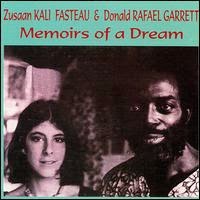
Zusaan Kali Fasteau & Donald Rafael Garrett ‎– 'Memoirs Of A Dream' (Flying Note)

You can count me among the fans of the Sea Ensemble's 1974 ESP-Disk album We Move Together; it's one of the less heralded ESP titles, coming so late, and maybe due to it not really fitting into any prevailing jazz scene at the time. Don Garrett is one of those figures who was integral to the 1960's free jazz movement without being recorded that many times. He played on Coltrane's Kulu SĂ© Mama and in the Archie Shepp band for a bit, and was generally described as being an energetic, visionary figure who knew and worked with just about everybody, without ever carving out much of a name for himself as a band leader or soloist. His long-term relationship with Kali Fasteau (they were married during the 70s) led to the Sea Ensemble, a duo group that somehow sounds like so much more. I came across this double CD at some point in my exploratory jazz phase and often throw it on when I want to escape into the fluid movement of wind. These are two live concerts, and they are flowing, evocative improvisations. The first disc is live in Leiden, 1975, and in two 15-minute tracks they start a whirling ball of organic sounds rolling that never really stops, though it has its ebbs and flows. It finally comes to a gentle, slow resolution where the air, channeled by these two, finds a resting place. The second disc is live in Turkey, 1977, towards the end of their relationship. This is divided into twelve tracks, all untitled, and has a less crisp, more woody fidelity. They start by speaking an introduction with some abstract language and then blow through some intense interactions. There is a lot of piano and upright bass, as well as the wind instruments heard so prominently on the first disc. The fidelity makes it sound a bit like a recording from the 1920's or at least the pre-modern times; this gives it even more of an otherworldly feel than the instrumentation does. There's a good bit of vocals here, sprinkled overtop like a spice, and the two get into a push-pull thing sometimes, particularly when both on wind instruments (I can't always tell what's what; some of the flute-like sounds feel too wooden in origin to be a proper flute, but then not quite a shakuhachi sound either). When it gets more of an edge (the double-bass bowing is warm and wet, but there's a more sharp, grating bowed instrument later on that when plucked sounds like a sitar or something Indian), it stands out from the other tracks. This musical freedom, where a jazz basis is synthesised with the pulse of worldwide traditional music, feels more like a way of life than a genre. Though many of my favourite 'jazz' artists trend towards this type of output (Alice Coltrane, Don Cherry, etc.), they're really outliers when compared to the standard jazz narrative, of Wynton Marsalis and Lincoln Centre and public radio and all that shit. Maybe this is just a bunch of hippie shit, but these artists found their path and stayed committed and true, and you can hear it between the notes and spaces of the recordings. The passion here is expressive, but it's as much about the overall artistic vision (visually, as well as in the way they lived) as it is about the sounds themselves. I find inspiration here more from that aspect than from the actual recordings, because as pleasurable and psychedelic as it can be to be carried on Fasteau and Garrett's flying carpets, it's more of a call to arms, to get off this laptop and pick up my busted-ass clarinet and start exploring my own outer spheres. That's not to diminish how great this is - it's an hour and a half well-spent, alive and breathing.

Sunday, 14 September 2014

Family Fodder - 'Savoir Faire: The Best Of' (Dark Beloved Cloud)

When Dark Beloved Cloud released Savoir Faire in '98 it came a time when this collective seemed defunct and long-forgotten; nothing had been heard since 1983's somewhat messy All Styles and this hybrid post-punk/experimental/art-pop band was music to my ears. The title track, opening things off, set the pace - a fast bit of aggressive art-pop with a French-sung bridge and two members of This Heat playing along. I was hooked and fell in love with this disc, which to this day is still the go-to Family Fodder record for me. Probably the greatest hits nature here is beneficial for this band, a ragtag collective that mostly gravitated around Alig Fodder and Dominique Levillain; being a completist gets you a few extra gems for sure (some of which we talked about on the vinyl blog) but the average Joe can survive for a long time with just this. There was a time almost 20 years ago where I could not believe such crazy sounds were hidden in rock's recent past; this was before the reissue fatigue set in and this sort of very British experimentation wasn't as commonplace. There's still an audacity and ridiculousness to 'Playing Golf (With My Flesh Crawling)', merging Residents/Snakefinger riffs and Eno-esque vocal delivery into something so fundamentally absurd it's become a classic. That it hews to a clever pop structure as well, with hooks, tension and release all delivered at the appropriate moments, is also key; Family Fodder are experimentalists in affect, lyrics, and production a lot of the songwriting is just bubblegum. Take 'Cold Wars', which in an alternate universe would have been a chart topping smash, or 'Film Music' (spoiler: it's empty); if only this songwriting talent had been used for less Gestalt purposes! But this is how I love it, a demented kitchen-sink mentality that did a lot to inspire my own music at the end and in the years following. Most of the Family Fodder singles are on here, which is nice as they are harder to find; this includes the double-punch of the Blondie 'Sunday Girls' cover (done actually pretty straight) and then the spastic rave-up 'DEBBIE HARRY', which at the time this came out was more well-known via Unrest's two sorta-covers, 'Winona Ryder'. A lot of British music in the early 80s was embracing dub and reggae forms and you hear a bit of this in Family Fodder, most notably in the dub take on an Erik Satie Gymnopede (or is it a Gnossiene?), though the curation of this disc otherwise stays away from that tip. Even still, it's a long way from an Adrian Sherwood production, being too self-consciously goofy. The last few tracks are where things trail off, containing their absurd 'Dinosaur Sex', a song I don't actually enjoy yet I can't imagine releasing a representative disc of Family Fodder without it, and a few later pieces from the 80s, previously unreleased, none particularly memorable. The last few years have got the band back together, though they haven't seemed to make much of a splash and I personally haven't heard any of it.

Wednesday, 10 September 2014

Fall of Saigon (Gazul)

By the time the first minute of Fall of Saigon has passed, the punchy opener 'Visions', I feel like I am listening to a slightly more aggressive version of Young Marble Giants. The simple synth pulses, gentle rhythms, and Florence Berthon's earthy, intimate voice are certainly from the same playbook, and this comes a few years later (1981-1984) so the influence is probably undeniable. But this was reissued probably due to the presence of Pascal Comelade, who later built a career performing in more experimental and improvised arenas, and these nascent tendencies are heard throughout. And when guitarist Terry Den takes over vocals, as on 'On the Beach at Fontana' (chanting a James Joyce poem) or 'She Leaves me All Alone', we get a more industrial, trance-like feel. His dour voice recalls the Cure or just about anyone else making dark punk-edged pop in 1982. (Could the band name refer to the This Heat song, or is it a reference to French political history?) This music is familiar through its obscurity, being another one of those rediscovered gems that keep surfacing at fairly regular intervals. That balance of serious and heavy lies throughout - there's fun live recordings of covers (Kraftwerk's 'The Model', TV Personalities 'Part Time Punks', and The Doors's 'The End') sequenced together in the middle, but it doesn't feel like filler, instead like a fleshing out of the personality of this band, represented 30 years later by this single CD. I don't know how Fall of Saigon fits into the trajectory of French art-rock; I so want to shoehorn them into some lineage between Mahogany Brain and Cheveu, but that's just forcing myself to rationalise great music into a historical narrative. The of-its-time sound and the covers inevitably situate this as a product of its time, but it's a time that we've been celebrating for three decades and I see no reason to suddenly stop.

Sunday, 24 August 2014

The Fall - 'Grotesque (After the Gramme)' (Cog Sinister)

This is a weird CD release because it pre-pends some early singles ('How I Wrote Elastic Man', 'Totally Wired' plus b-sides 'City Hobgoblins' and 'Putta Block'), but without anything in the liner notes indicating that. So 'Pay Your Rates' actually kicks in as track 5, and then Grotesque proper begins. Not a problem here - the singles complement the album perfectly - it's just that I only know what the song titles are thanks to my familiarity with the tracks (and the Gracenote CDDB database, of course). Repetition, cited often as an early Fall motif, is maybe most prominent here of any of these early releases - 'Pay Your Rates', 'New Face in Hell' and 'C n CS Mithering' (not to mention 'The NWRA'!) are insanely monotonous, drilling into one's brain with their back-and-forth soul-sucking. It's like a Michael Snow film, except with Smith's sneering lyrics providing a wild unraveling. 'English Scheme' has always been one of my favourite Fall songs, maybe due to the way that the carnivalesque keyboards blast over everything and the geographic evocations within the lyrics tweak my own fascination with British maps By this point, The Fall have evolved out of the punk thing entirely and arecreating something intangible but about their lives in Manchester. It's more confident, perhaps, less prone to hiding between Smith's bile. The keyboard and guitar interplay on 'New Face in Hell' is practically jazz. 

Wednesday, 30 July 2014

The Fall - 'Dragnet' (COG Sinister)

I guess this is the second Fall album and it's just about perfect. It's recorded with a bit more of a gritty feel than Live at the Witch Trials and the songwriting seems more obnoxious (that's a good thing!) and the great Craig Scanlon has joined the band at this point, able to exude the maximum dissonance within what is still technically a pop song. You can hear it in 'Psykick Dancehall' which builds up a repetitive, annoying high-pitched riff during it's climax. Mark E. is ripping it up too, snarling throughout stuff like 'Printhead', a dark mishmash of punk and DIY singles and whatever else was happening in 1979 Britain. The original liner notes are reproduced here in annoyingly small CD quality, and maybe it's best summed up by Mark E.'s own bio, about his visit to the dry cleaners: 'How did your coat get so dirty, Mr. Smith? What do you do for a living? Answer: I hang around old buildings for hours and get very dirty in one of those hours.' Genius, I guess; dirty buildings do fill the corners of Dragnet, even if it's the 'Flat of Angles'. The longer form jams ('Spectre vs. Rector' and 'A Figure Walks' which is utterly brutal in its monotony) take the promise of early single 'Repetition' and run the course. The people making this would probably never have imagined that anyone would consider it a 'classic' today.

Sunday, 11 May 2014

Fairport Convention - 'House Full' (Hannibal)

Here's one I got for free somehow, which is a live recording of the 1970 Fairport lineup, post-Lamble, post-Denny. Just five guys trying to make the best of their iconic vocalist's departure. The liner notes, written by Joe Boyd in the 60s, are somewhat dismissive of the Full House album and of later Fairport in general (referring to a 'long, slow, sometimes ungraceful but always spirited decline'). But he insists that this 1970 band was a tight unit, not captured on the studio recording, and thus this live gig from Los Angeles in September 1970 is presented to support his argument. It's a good live recording - a bit lacking in the low end, but this is a CD after all - and the 'reluctant vocalists' Thompson and Swarbrick (again, Boyd's words) sound pretty confident to me, especially on 'Banks of the Sweet Primroses' where they exude a casual confidence which sounds striking, or maybe I just like English accents. The band is overall playing a bit fast, or at least with a spring in their step. The instrumentals are particularly fierce - 'Mason's Apron' sounds like something off Camper Van Beethoven's second album, and the climax of 'Matty Groves' never sounded better. As a band, the material has shifted really strongly towards the 'folk' in 'folk-rock' (which is a nice juxtaposition with the Heyday CD we just listened to) and also leads to more extended meandering solos by Thompson, which are always welcome. He seems to just stick some extra notes in hidden places, here and there, and it's a casual grace that he masters when he starts making solo records a few miserable years later. The centerpiece, of course, is 'Sloth' - I've already proclaimed my love for this song elsewhere, and that remains on this version, if it isn't amplified. The fierce buildup about 8 minutes in is even more aggro than the studio version, and the raw live edges are perfect for the come down, when Swarbrick starts to delicately pluck the violin strings around the cadence. It's like he's trying to tease the beast of a melody into revving up again and it works wonders. I love this song and even though this lineup of Fairport is slightly lackluster,  I can't imagine 'Sloth' with Sandy Denny -- the sense of resignation and frustration is distinctly male. The closing cut, 'Battle of the Somme', is delicate in a way that it feels out of place, especially after 'Mason's Apron', but maybe that's just my own itchy nervousness coming into play.

Saturday, 10 May 2014

Fairport Convention - 'Heyday - BBC Radio Sessions 1968-69/Extended' (Island)

Heyday was Fairport's album of radio sessions from the early era of the band, but not the earliest - it's all Sandy Denny here, sans-Dyble, and while they were theoretically writing material like 'Meet on the Ledge' and recording albums as great as Unhalfbricking, this collection shows them cutting loose and mostly delivering rave-up cover versions. If Fairport was folk-rock, this shows that the rock came first; the only British traditionals appear as the bonus tracks, though this CD is all about the bonus tracks. I actually had the original Heyday CD, which was only the first 12 cuts here, and then upgraded to this expanded reissue when it came out. The album proper is almost a classic of its own - the band goes through Joni Mitchell, Leonard Cohen, Johnny Cash and Gene Clark songs with varying aplomb, and there's a few originals such as the great 'If It Feels Good, You Know It Can't Be Wrong', by Thompson and Ashley Hutchings. Of course, no more false words have ever been written, but on that track, the debt to American rambling folk-rock is laid on thick. This is perhaps the least British Fairport Convention ever -- their smashing version 'Reno, Nevada' shows how much they fetishised American folk culture -- but some of the most fun. And Joe Boyd contributes to the liner notes, explaining how he pushed them to define a more distinctly British sound, which I think everyone can thank him for. These are Peel Sessions from before the term really existed and thus have that thin, spontaneous Maida Vale sound, with reverb on the live vocals (most evident on 'Fotheringay's haunting background voices and 'Si Tu Dois Partir'). It's only the bonus disc that starts to creep later, material-wise, into 1969 and into far more British fare. Here we get 'Nottamun Town', 'Fotheringay', 'Reynardine' and 'Tam Lin', all of which defined and distinguished Fairport Convention from the other masses of Dylan-gazing folk-hippies, and you can hear why. Thompsons's shredding on 'Nottamun' is great with Martin Lamble's congas, and it's like a hash den at times, all the more affecting when juxtaposed with a strident Jackson C. Frank cover. The version of 'Tam Lin' to close it out is a scorcher, as good as the album version and a million miles from 'Gone, Gone, Gone' earlier on the disc. It's an appropriate finish to something as conclusively 'fun' as this album, with a burning light that lingers after the disc has stopped spinning.

John Fahey - 'God, Time and Causality' (Shanachie)

This late-period Fahey (but predating his 'experimental' comeback on labels such as Tim/Kerr and Table of the Elements) is a gem, combining the expanded blues ragas of his early work with the more direct, punctual guitar tone found in his 80s recordings. He revisits some old tunes here, making this a key document of how an old master continually reinvents himself. Maybe it's wisdom and age, but God, Time and Causality announces itself right off the bat with 'Revelation', which according to the liner notes quotes Charley Patton. It then segues into 'The Red Pony', a thundering, almost violent epic that roars and flows for about six minutes. A new version of 'Lion', last heard on The Yellow Princess, follows, and the liner notes metions that this is stolen from an obscure blues guitarist named Walter Hawkins, and that the flamenco flourishes were also Hawkins'. This is such an iconic Fahey tune to me, and hearing it twenty years after the last recording illustrates the 'time' part of the album title. 'Requiem for Mississippi John Hurt' is also revisited as the second part of a medley and it becomes such a lifting, magical ride that I probably can't tell it's recorded 20 years after the version on Requia. There's a bed of overtones here, a warm glow from the speedy repetition which lingers on during the changes.  Fahey's 80s output is often overlooked and Rainforests admittedly feels minor and reaching, but God, Time and Casuality really can stand against any of his classic late 60s albums, so if anything this illustrates the biases of time (there's some causality for you). My own accumulation of Fahey recordings ends here, but I would like to check out Womblife again, because I remember it embracing electric reverb and delay pedals with a vigor not even hinted at in his earlier electronic tendencies, and while I didn't care for it at the time (preferring the definitive acoustic Fahey) I think that after listening to a few of these albums sequentially I would feel more of the context to support it (which is kinda really why I do this, you know)....

Sunday, 30 March 2014

John Fahey - 'Rain Forests, Oceans and Other Themes' (Varrick)

Fast-forwarding nearly two decades from America, Fahey here delivers a set of mostly-covers, recorded live in an old church. He's accompanied by Terry Robb on about half the tracks, and the effect is jarring if you're used to the expansive songs of his 60s records. The opening track, 'Melody McOcean' (one of the few originals here) already sets a tone - the melodies are more carefully pronounced, building on tones in a way that makes me think about melodic indie guitar bands like Bedhead who followed in the 90s. There's quite a bit of distortion on these notes, which is odd given the liner notes which go on about the recording process and the delicate nature that was in the old church-studio where it happened. It is a great large room and the harshness of the CD format really pushes up against it, making some of the highs almost too-brittle to enjoy. If this is Fahey in pastel, it's OK by me - 'Melody McOcean' has an epic grandeur that while less dusty than his earlier work, shows a development and the same brilliant compositional ear. 'Rain Forest' is a bit more strummy, and a few of the shorter pieces such as 'Atlantic High' and The World is Waiting for the Sunrise' take on that old magic. This is definitely a cooler album and I'm not just saying that cause it's about rain forests and there are waves on the cover; the tonal qualities of the guitars, no doubt due to the recording style, are glossier and echoey. The wooly transfigurations here merge into a spacious breeze, and the numerous covers make this feel even more alien. Clapton's 'Layla' is the first one, and it's pretty straight-forward as it goes, and I must say dazzling when Robb and Fahey intertwine in a speedy manner. A Moondog  piece makes an appearance, and there's some synth, percussion and bass to fill that out (cause you need rhythm with Moondog!) - it's an odd collection of sounds, more malevolent than Moondog usually is, but with some nice ringing open chords to balance the strange modes. The most curious cover is probably Stravinsky's 'The Firebird', as the second part lets the room ambience drift over all. It's beautiful and fragile; you can almost feel a fireplace burning in the background as the final resounding strum mockingly dismisses the theme. 

Monday, 17 March 2014

John Fahey - 'America' (Takoma/Fantasy)

At the deepest point of my Fahey interest (1999-2001, roughly) I was convinced beyond any doubt that America was his masterpiece - though I must say that I hadn't heard them all, and still haven't. This was due largely to a friend uncovering a vinyl copy; he dubbed it to a tape, and during a long afternoon drive across central Pennsylvania we listened to it while trying to stay awake and the synergy was magic - the long sweeping guitarscapes were a perfect complement to the dim light of I-80, with rolling hills in the distance that seemed to write their own elegies. I immediately ordered this CD, which strangely expanded and contracted the LP at the same time. A lot of additional material was added - the first nine tracks, in fact - but one of the LP tracks was shortened to fit the fascistic 75 minute runtime of a compact disc. But it's great in both formats; I can't, at this point, imagine America without the beautiful 11-minute 'Dalhart, Texas, 1967' or the incredible version of 'Amazing Grace' (the best these ears have ever heard, with piercing shards of guitar cutting through the nonbelievers like machine gun fire). And neither were on the original LP. When we finally get around to it, I'm taken back to that drive and the transformative power of music (or whatever clichĂ© you prefer) is in full effect. America is built around two 15- minute tracks, 'Mark 1:15' and 'The Voice of the Turtle', and the longer formats are where Fahey shines the most (although the former, I believe, is the truncated one). These pieces take their time to build, and especially in the case of 'Voice of the Turtle', represent probably the fullest evidence of his guitar genius. The shorter tracks are also great though - 'Dvorak' is celebratory and when looking at the strange, primitive artwork ('The destruction of Takoma Park, Maryland') while listening to it, it feels spooky. This is no longer necessarily my favourite album of his - I would probably take the wistful longing of Days Have Gone By, or just decline to pick one - but it's a formidable entry into American music. The title seems to acknowledge this, and while it's easy to inject a whole lot of context into your work by titling it 'America' (I'm looking at you, Baudrillard), it's fitting for the self-made man he was. I'm always drawn to the way mid-century American artists dealt with space, to me one of the fundamental issues of American culture - and the long format improvicompositions here breathe in and exhale, like a William Carlos Williams poem. The title track itself (left off the original issue!) is perhaps the most impressionistic part of the album, with a resonant high-register introduction before the resounding, aggressive strides of the main theme kick in. It's easy to think of this as the whole 200-year history compressed into a 7 minute instrumental guitar piece and I'll succumb to that analysis. Though it's lacking any musique concrete experimentation or weirder elements, this is Fahey's magnum opus for sure, and it's been recently reissued in full on vinyl so I'll probably make the conversion soon - which is the first time it's ever all been together, even if only two minutes are missing here.

John Fahey - 'The Yellow Princess' (Vanguard)

Fahey goes 'serious' in the liner notes here, explaining that he's tired of writing humorous record notes, for 'such publicity stunts are no longer necessary'. Then it transforms into a beautiful description of the title piece, written for a boat, and with a description of one's place in the cosmos, Whitman-motivated, that is as stirring and majestic to read as the composition is to hear. 'The Yellow Princess' is Fahey strumming and picking frantically in standard tuning, creating a dazzling array of  guitar sounds. It's a momentum picked up a few tracks later in 'Lion', an open-G eulogy to his housecat that moves through moods, appropriately given it's inspiration. The Yellow Princess overall shows Fahey in the extremes - slow, mournful picking and jaunty whimsicality both share a loveseat. The longest piece is 'Irish Setter', another one for a pet, but that's only 7 minutes, making this very digestible overall. Fahey's accompanied by a band on two tracks, but it's minimal - 'Dance of the Inhabitants of the Invisible city of Bladensburg' is actually one of the most spare pieces on the disc, starting with a few cautious steps before building to a swirling tornado, with an additional guitar adding a shimmery, bendy feel to a lengthy buildup. Fahey leans slightly more towards severity, and away from beauty, with modal progressions and minor key explorations ('Irish Setter', 'Charles A. Lee: In Memoriam'). But when he drives straight-ahead with simplistic wonder (as on the sublime 'View'), it provides the complete yin-yang of the Fahey spirit, and you start to see what his reputation is based upon.

Tuesday, 24 December 2013

John Fahey - 'Requia' (Vanguard)

I don't have any Fahey records on vinyl, but would love to find at least America (as it differs from the CD version), as hearing his guitar picking bathed in scratchy, late-60s vinyl atmospherics is surely wonderful. But despite my general dislike of the glass-mastered format, the mastering job on Requia is done right. The first sharp tones of 'Requiem for John Hurt' jump out of the speakers, so clean, and right up against my ears as if they're right over my shoulder. Maybe we're all used to listening to music through laptop speakers now, but this is music that still feels alive, even though it's approaching a half-century mark. Requia is also notable for it's 4-part, musique concrete-laden 'Requiem for Molly', which occupies most of the second half of this album and finds Fahey at his most experimental, at least until Womblife came around in the late 90s. And for those trying to truly understand Fahey, maybe this is the key. The liner notes explain how he started playing guitar in the 1950s but he failed to find the freedom he sought; while not directly relating this sense of constraint to the tape experimentations of 'Requiem for Molly' it's hard not to draw the parallel. As a tape piece, it's all over the place. Sped up loops and voice samples recall Steve Reich's tape work from around the same time; the incorporation of marching bands, funeral music and other earlier American styles, over which Fahey alternates between a mournful chordal progression and more abstracted slide playing and frantic picking, makes a chaotic tapestry that nonetheless retains its appropriate colour throughout. Actually, it makes me feel a bit of the same ur-Americana as Van Dyke Parks' Song Cycle, released nearly the same time. The other tracks on Requia are solid too; 'When the Catfish is in Bloom' is described as a 'cantica' (along with the closing beauty, 'Fight On Christians, Fight On') and it's alcohol-fueled composition, described in the liner notes, makes me wonder if Richard Brautigan was sitting in the coffee shop where it was composed. The cover of this is also wonderful - Fahey looks a bit like a traveling door-to-door salesman, with his tweed jacket and skinny tie. His position is straight-forward, the way a "folk" record should portray him, as he just looks like a nice young man. There's nothing visible here to indicate the far-out sounds on (imagining this is a vinyl original) side two. But they're not actually that far-out. Compared to the forced surrealism of, say, Zappa's earliest work (which we must admit we'll probably never reach in this project) or even After Bathing at Baxter's, the tape collages of 'Requiem for Molly' are naturalistic and even subtle -- making this a musique concrete work that you could play for your grandmother. Especially when it's made by what looks to be such a nice young man.

Monday, 23 December 2013

John Fahey - 'The Legend of Blind Joe Death' (Takoma)

According to discogs.com, Blind Joe Death has been issued 12 times, and what makes it confusing is that Fahey re-recorded parts of it later in the 60s. This is a semi-authoritative release, though it's not for completists, which I'm not. As a document of Fahey's earliest style it's good enough for me. We all know this was a unique invention, an American folk guitar form that was set forth assertively and influenced legions. The blues roots are inevitable; most of the Blind Joe songs follow a 12-bar or similar pattern. But somehow Fahey's playing doesn't raise any of the usual questions about race or authenticity; it's a confident and singular vision that is also flexible. There's a remarkable variety of mood here, from the spare melancholy of 'On Doing an Evil Deed Blues' to the thick, reverberating grandeur of 'The Trasncendental Waterfall', whose length and title alone indicate you're in for a ride. Having listened to a bunch of Fahey in the past, there's a lot of familiarity to the cadences, the pauses, and the sense of motion. When Fahey's own voice introduced the last track, "West Coast Blues', there's something chilling about hearing him so young, especially as my introduction to his work was with his late 90's "comeback" recordings (and the time I saw him live and met him was shortly before his passing). The idea of re-editing an album and releasing it multiple times, making no version truly authoritative, is a radical one. It makes the record feel like a living, evolving work with no necessary endpoint, and that feels somewhat progressive for its time, though I doubt it was its intention. Maybe Blind Joe Death is the Google Docs of acoustic guitar records; additionally, the presentation of the recordings as being by Blind Joe Death could raise all sorts of postmodern questions about authorship, etc. None of which was Fahey's intention, of course, but it's a funny way to reinvent this. And if the man was about anything, it was reinvention.