HEY! Get updates to this and the CD and 7" blogs via Twitter: @VinylUnderbite
Showing posts with label internal logic. Show all posts
Showing posts with label internal logic. Show all posts
Monday, 15 September 2014
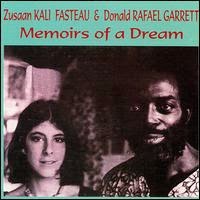
Zusaan Kali Fasteau & Donald Rafael Garrett – 'Memoirs Of A Dream' (Flying Note)

Saturday, 14 November 2009
Captain Beefheart and His Magic Band - 'Grow Fins: Rarities 1965-82' (Revenant)
 I guess this is the first of a few 5CD boxsets in the Glass Mastered Cinderblock project. We've been spared the 11 CD Albert Ayler set because it doesn't fit on the regular spined CD shelf, but this one just squeaks in under the size limit of my cheapass Ikea CD rack, so here we go!! Listening to Grow Fins is a mammoth undertaking but it's a treasure for sure. When it first came out I really gravitated towards the fifth disc, which is pretty much everything from post-Trout Mask til the end. But these days I get a lot of grooves out of the 60s material and this set is weighted a bit in that direction, so now I'm just kicking myself for not having played this much in the past six years. Disc one, Just Got Back From the City (1965-67) is, as you would guess, the earliest recorded Magic Band demos, none of which were ever released before and only a few tunes ('I'm Glad', 'Yellow Brick Road', 'Sure Nuff n Yes I Do') ever really turning up in other versions. 'Obeah Man', which is the first track, is almost shocking in how frantic the band is going at it for 1966. Everything on this disc dates from '66 and '67, except for a pretty spooky and awesome acetate demo of 'Call On Me'. You'd expect a lot more conventional balladry like 'I'm Glad' but you don't get too much - there's a lot closer connection to traditional blues (like shoutouts to Tupelo, MS in the track of the same name) and uptempo rockers. Doug Moon is the guitarist of note here, I think - some of his ragged squiggles are pretty bent given that Van Vliet hadn't really busted anyone out of their shells yet. But it's not necessary to seek the 'out' in this early stuff - it's perfectly fine to enjoy it as a really great, cranking blues-rock band with ragged psychedelic flourishes. The familiar songs, well, they sound pretty much like demo versions of the Safe as Milk songs - more raw, a bit less fidelity, and without Ry Cooder. Though I don't know that it really makes a difference whether it's Cooder or someone else. As you listen to Grow Fins straight through (which is not something I've ever done before), you really see the narrative that it constructs. Disc two, Electricity 1967-68, is aptly named - mostly live recordings, you can hear things are starting to click. This version of 'Sure Nuff' has a bit more oscillating and a bit more crunch. 'Rollin n Tumblin' is a reprise with different lyrics, somewhat murky (probably an audience recording) but you can hear the band achieve a new level of smokin' - it's a bit rougher and more passionate, as opposed to 'Obeah Man's more controlled energy. This band is Jeff Cotton and Alex Snouffer/St.Clair, and they straddle the line between jam band and visionaries. The extended solos are a bit more directed towards conventional concepts such as melody and harmony, but they still know how to buck and jaw and fight each other. Vliet's there on the shenhai or something - it's distant but it's perfect. If you listen close enough, I daresay you can hear some Trout Mask melodies poking through. 'Yer Gonna Need Somebody On Your Bond' is clearly the root of 'Tarotplane' and the one non-live cut here is the languid 'Korn Ring Finger', somehow strained in it's casual gestures.
And then, it's on to disc three, the Trout Mask House Sessions - 73 minutes of practices and aborted runthroughs, a document of one of the most legendary recording sessions in the history of music. Right, but what does it sound like? It's perplexing, presented in a pretty raw format with background ambience, dog barks, lots of conversation and strange gaps between performances. If you believe in the cult-like legend of Trout Mask (meaning that DVV ran the recording like a cult preparing for some sort of elaborate suicide ritual - the discipline of the North Korean Arirang crossed with the Manson-like intensity and dedication to purpose) - then it's the house itself that radiates the aura. This is a record made inside a house, even if the final product was laid down in a studio, and the way it's presented here is like a true House of Fiction, straight out of Henry James. As a document of collaged anti-music it would fit right in as a Siltbreeze release or some sort of post-Homosexuals side project; but it's also a stunning revelation into how these classics were constructed. I found this disc pretty hard to listen to when I first got this box set (which was about ten years ago I think -- back when 'enhanced CDs' were the rage) but these days I think it stands up well on its own, even if you've [somehow] never heard Trout Mask Replica. Clearly Revenant felt that this should be the centerpiece of the box set, even though it occurs relatively early in the career of the Magic Band; I agree, now. Though Van Vliet was allegedly dictatorial and take-no-prisoners in his rehearsal schedule this disc is fair to the band. You get a lot of Van Vliet soprano skronk but otherwise you really hear the musicians working things out. When the familiar riffs break through after all the faffing about, it's like hearing a song you've been waiting through the whole concert to hear, so it's that much more rewarding. The fidelity is surprisingly great too -- thank god the recorder was running.
The recorder kept running enough to put 12 minutes onto a fourth disc, called the Trout House Sessions [storytime portion]. And that's a continuation of the conversation and babbling we hear in glimpses on disc 3, though I can't admit that I've ever paid enough attention to follow any narratives. It does explode into 'China Pig' at the end but that's about all it's got going on the musical tip. This listen was no better for me - too easy to get distracted. If you dig the nonsense that led to the infamous 'Fast and Bulbous' conversations this is the disc for you. But really, the bulk of this disc is the Enhanced CD portion, cause this was released at the tail end of the whole Enhanced CD craze.
And then finally disc 5, Grown Fins [1969-82] which pulls everything else after Trout Mask onto one messy disc. Admittedly this was the disc that won me over the most when I first got this box, but that's cause I wasn't too familiar with the later era of Beefheart's work. Listening now I'm slightly annoyed by the poor fidelity of the (mostly) live tracks. It works well on some tunes, like the opening version of 'My Human Gets Me Blues' from '69 - it's so blown out and uneven, with certain instruments far more audible than others, that it actually sounds like something that would come out of LAFMS -- far more weird than it probably sounded in person. There's some cuts of the Decals band doing Trout Mask songs - the marimba bursting through on 'Big Joan' is particularly hot - and then a slow progression through the 70's via live and radio tracks. The Bluejeans/Unconditionally material is totally bypassed and we skip ahead to a 1975 radio version of 'Orange Claw Hammer' with Zappa strumming chords underneath. I used to love this version but now I'd prefer to hear the original pause-button edited version; Zappa instills an actual cadence into the song that ruins it a bit. But I shouldn't be too critical of this disc cause it's still the most diverse and fascinating of the set; the two versions of 'Odd Jobs' (a piano demo and a full band blowout) are pretty different though sadly marred CD skips on my copy; the Mellotron improv tracks are brilliant bits of sound-Dada; the title track sounds a bit better here than on the record. I do question why Revenant didn't include the original version of Bat Chain Puller - I suspect rights/legal reasons are the answer, but it's still disappointing because it would have balanced this set a lot more. It's a lot to take in, and if this post feels a bit disjointed that's because I listened to this in pieces (as to be expected for a 5 disc box set). I should say something obligatory about the box and book which are lovingly designed, managing to convey psychedelic design without seeming overly retro; it's Weird enough, though a bit difficult to read and the glue is starting to separate on my hardcover book. Drumbo's story is pretty essential and it makes up for John Corbett's overly enthusiastic descriptions of the disc's contents.
Tuesday, 6 October 2009
Bedhead - '4songCDEP19:10' (Trance Syndicate)
 Bedhead's records all have a really similar design and this weird mishmash of numbers like a private barcode, in which BH0x is always present with x being the number of the release. WhatFunLifeWas is actually BH03 and I have all the subsequent ones so they must have had a debut 7" or two that I still need to complete my collection. Which I would love to do, because as I mentioned in the previous post, I love this fucking band and it's here where they start to hit their stride. This EP, BH04, was recorded in a big empty Texas church on one microphone. Unlike their studio recordings, these 4 songs are light and slightly more strummy, letting the room sing through the notes. 'Heizahobit' opens up with a real Feelies The Good Earth feeling, a sound not given lightly despite it's apparently lack of weight. 'Dead Language' is an all-time Bedhead fave, where the vocals come to the forefront though they are no less gentle; lyrics that seem to touch on war and skin and graves and something personal all at once. Despite the 100 times I've listened to this song I've never bothered to look for literal meaning, instead being satisfied to let the jaunty bounce of the drums and the slightly awkward melody set some sort of mood. Yeah, it's the most folky Bedhead moment probably, and it seems like they've relaxed a bit but stayed focused, which sounds like a contradiction but this is a band that contradicts itself more as you sink deeper into their music. 'WhatI'mHereFor' is a repetitive riff led by a solid, consistent drum that again devolves as it goes along while sticking to the pattern. The last track is a cover of Joy Division's 'Disorder' which I will say without hesitation blows away the original. The booming sound of the church is the lead instrument and Ian Curtis's vocal dramatics are replaced by Matt Kadane's existential murmur. Without any trace of hysterics the song still screams with pain, with the lackadaisacal repition of the two-note guitar lead driving the point home. The 'you've got the spirit/don't lose the feeling' part rises to a new intensity unheard in the original that somehow feels more genuine to me, even though they didn't write it. With an approach and palette like this, it's hard for Bedhead to ever come off as false or disingenuous. The 19 mnutes 10 seconds that embedded in the title end and it's all been very satisfying. This may be the black sheep of the Bedhead catalogue, but it's a place worth visiting regardless.
Subscribe to:
Posts (Atom)